Dim Sum Mania
Dim Sum Mania Review: Every Reel Has a Price After the Spin
Dim Sum Mania appears to be a light food slot built around steamed buns, tea and a busy Cantonese restaurant. The cheerful dining room is only half the story. Once the reels stop, five small prices appear below the grid. Each price belongs to a different reel, and paying it spins that reel again while the others stay in place.
That second decision is the real game. A normal spin reveals the symbols, but the result may also create a partly completed combination, two Free Spins symbols or a promising stack on the first reels. Dim Sum Mania then asks if one frozen screen is worth modifying through a paid single-reel respin.
Pocket Games Soft released the title on August 13, 2020. The cabinet uses five reels, three rows and 243 ways. Listed RTP is 96.75%, volatility is medium, the regular stake range is 0.25 to 25 credits, and the advertised maximum is 20,000 times the bet. These figures are recorded on the Dim Sum Mania listing at SlotCatalog, while the actual rule screens explain the less obvious details behind the paid respin system.
The bill arrives after the main spin
Many slots place their main choice before the reels move. Dim Sum Mania reverses that order. The paid spin finishes first, the game exposes the whole grid, and only then does it show five reel-specific respin buttons.
This timing changes the nature of the decision. The extra cost is attached to a visible position rather than an unknown starting screen. Four reels remain fixed, so the likely purpose of each available respin is apparent. Reel five might be the only gap in a five-reel symbol chain. Reel three might hold the Wild that links both sides. Another screen might show two Free Spins symbols, leaving one required for the bonus.
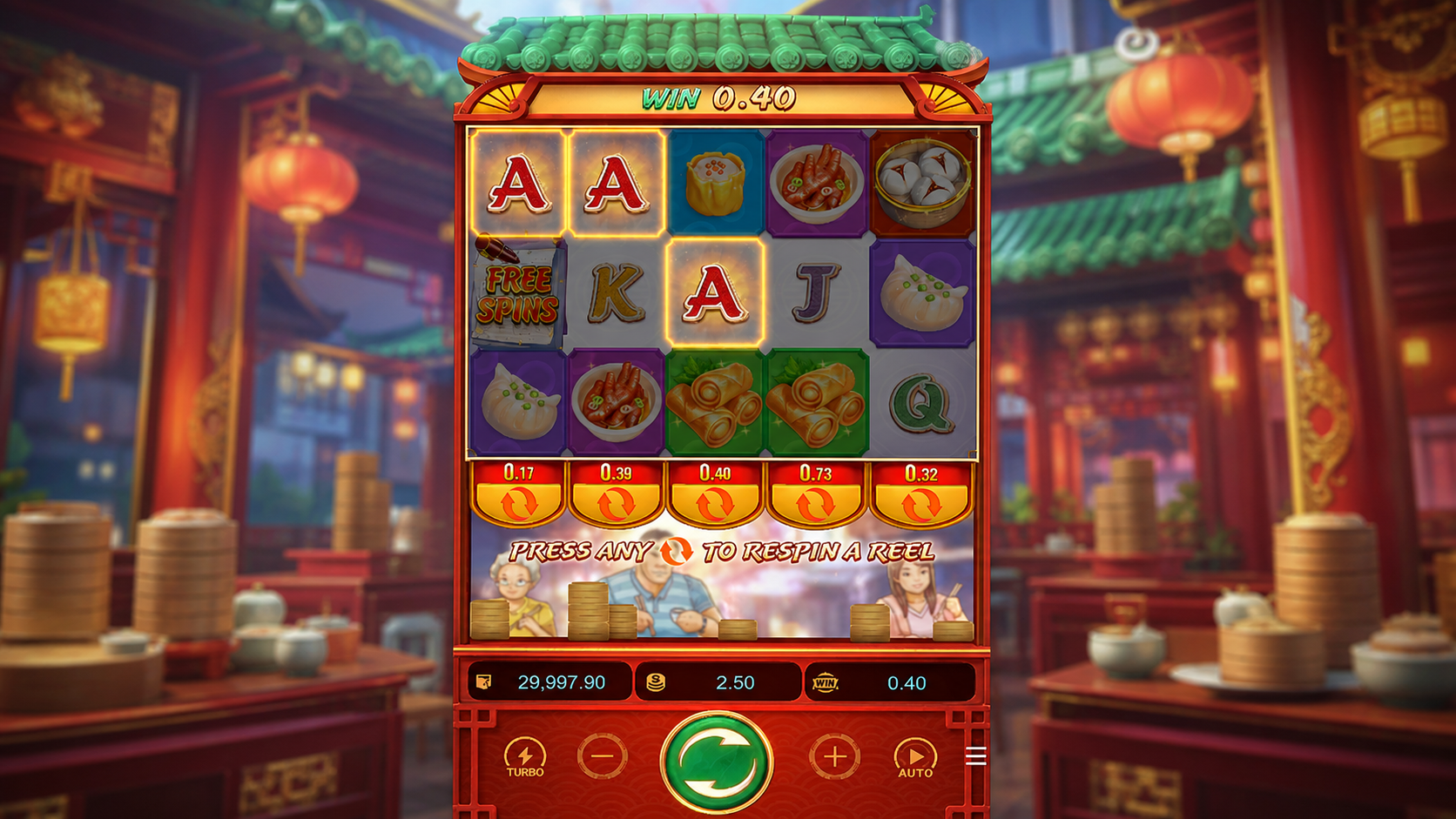
The five prices need not match. In the captured game screen, the displayed reel costs are 0.17, 0.39, 0.40, 0.73 and 0.32 on a 2.50 base spin. The in-game rules state that each reel price is calculated separately. They also make a point that the amount does not indicate a greater or smaller chance of winning.
That warning matters. A price of 0.73 is not proof that the fifth reel is more likely to land the missing symbol than a reel priced at 0.17. The amount belongs to the mathematical value of changing that part of the current position, not a visible probability meter.
A 243-way grid that still starts on the left
The 5-by-3 format creates 243 possible symbol routes because each of the five reels has three positions. Three multiplied by itself five times equals 243. This does not mean every matching group anywhere on screen pays.
A standard combination starts on the leftmost reel and moves through adjacent reels. A symbol on reels two, three and four is not enough if the same symbol is absent from reel one. Gaps also break the chain. Reels one, two and four cannot form a valid route without a match or Wild on reel three.
The number of winning ways for one symbol is calculated by multiplying its matching positions across the connected reels. If two copies land on reel one, one lands on reel two and three land on reel three, the screen contains six three-reel ways for that symbol. Another matching position on reel four would keep all six paths alive. Two matches on reel four would raise the count to twelve.
This multiplication is why a single-reel respin can matter. Replacing one column may affect many routes at the same time. It may extend several existing three-reel ways to reel four, or it may destroy an unhelpful column and insert a Wild that supports different symbols.
The game uses a fixed base-bet structure of 25 units for its 243 ways. Bet size runs from 0.01 to 0.10, while bet level runs from 1 to 10. The normal 0.25 minimum follows from 25 multiplied by a 0.01 bet size and level 1. The 25-credit maximum follows from 25 multiplied by 0.10 and level 10.
That structure explains why 243 ways do not require 243 separate line stakes. The displayed total bet is based on 25 base units, while the symbol routes are evaluated through the ways calculation.
Food symbols do more than decorate the cabinet
The regular symbol set is split between card ranks, several dim sum dishes and two diners. J, Q, K and A sit at the low end. Dumplings, siu mai, spring rolls and plated dishes occupy the middle. The young woman and bespectacled man are the premium character symbols.
The male character is the highest regular symbol. The paytable lists 10, 40, 400 and 4,000 units for two through five consecutive reels. The woman pays 5, 25, 250 and 2,500. The basket of steamed buns reaches 2,000 for five reels, while spring rolls reach 1,000.
These values are not automatically cash amounts. The in-game rules multiply the listed symbol value by bet size and bet level, then multiply again by the number of winning ways. Several copies of the same premium symbol across consecutive reels can therefore create many routes at once.
The food artwork helps the grid more than the restaurant story does. White steamed buns sit on purple tiles, yellow siu mai sit on blue, and fried rolls use green. Those tile colours separate similar beige and gold dishes on a small phone screen. The dishes remain identifiable even when the reels move quickly.
The diners beneath the reels give the cabinet a little motion between spins. An elderly woman stacks bamboo baskets, a man works behind the counter and a younger woman stands at the right. They make the paid respin row feel like part of a working restaurant counter rather than an abstract control strip.
The Wild belongs to the middle of the meal
The porcelain teapot is the Wild. It replaces every standard paying symbol but does not replace the Free Spins Scatter. According to the in-game rules, it appears on reels two, three and four only.
This is worth stating because several secondary reviews say the Wild appears only on reels two and four. The actual game-rule page includes reel three as well. That middle position is especially valuable in a ways slot because it can connect symbols from the first two reels to matching symbols on reels four and five.
The Wild never appears on reel one, so every regular way still needs a natural symbol at the start. It also cannot land on reel five, which means a five-reel route needs the target symbol naturally on the final reel. The Wild improves the interior of a chain but does not remove both endpoint requirements.
A Wild on reel three may support several symbol types simultaneously. If reels one and two already contain both dumplings and spring rolls, the same teapot position may substitute inside routes for each group. The ways system then counts each symbol independently.
There is no Wild multiplier in the normal game. The teapot is valuable because of substitution and route multiplication, not because it attaches an extra numerical factor. The flat x3 belongs to Free Spins and applies to the finished win rather than to the Wild itself.
The five orange buttons are the main mechanic
After a main-game spin, the orange circular arrows below the reels become selectable. Each button shows the current cost for respinning its reel. Selecting one causes that column to move again while the remaining four columns stay fixed.
The feature can be used multiple times at additional cost. It remains a sequence of separate paid events rather than one complimentary retry. A second press creates a second charge. Repeating the action does not turn the next respin into a free one, and the visible price may change with the resulting screen.
Only new winning combinations formed by the respin are paid. This rule prevents an existing win from being collected again merely because an unrelated column moved. Suppose the first three reels already contain a paying dumpling route. Respinning reel five does not pay the untouched three-reel route a second time unless the new reel creates a new qualifying combination under the game rules.
That distinction is central to evaluating the feature. The grid may still show glowing symbols from the original result, but they are not an endlessly reusable prize. The respin must form a new route, extend a route or trigger the Free Spins condition.
The feature is limited to the main game. It disappears during Free Spins, where every win already receives the fixed x3 multiplier. The game therefore has two clearly separated modes: a base game with paid control over one reel, and a bonus with automatic spins plus a global multiplier.
Changing the bet amount also disables Reel Respin until the next normal spin ends. This keeps a position generated at one stake from being modified at another. The displayed reel costs and the frozen grid belong to the bet that created them.
Why a respin price is not a forecast
The unequal prices make it tempting to read hidden information into them. The rules directly reject that interpretation. A higher price does not signal a better chance, and a lower price does not signal a weak reel.
The game can calculate value from the current arrangement without changing the random reel-strip probabilities. A reel surrounded by many potential premium routes may be more expensive because replacing it has greater mathematical effect. That is different from saying the next stop is more likely to win.
The selected reel also has two possible jobs. It may need to supply a missing symbol, or it may need to preserve an existing set of symbols while improving another route. On a ways grid, a column holding three useful matches may be too valuable to disturb even if its displayed respin cost is low.
The game does not mark a recommended reel. All five arrows share the same visual weight, and the decision remains with the user. This is a better fit for the mechanic than a glowing suggestion because the screen may contain several competing goals.
A respin aimed at a five-reel premium combination differs from one aimed at Free Spins. The first needs specific natural symbols on the final reel. The second only needs another Scatter anywhere because Scatter awards do not follow the left-to-right ways rule.
Two Scatters already carry cash value
The order-pad symbol marked Free Spins is the Scatter. It pays anywhere on the grid, beginning with two copies. The paytable lists 25 units for two, 50 for three, 250 for four and 2,500 for five.
Three, four or five Scatter symbols all start the same 15-spin feature. Landing more than three increases the Scatter award, but it does not raise the initial number of spins beyond 15. This is an unusual split between trigger quantity and bonus length.
Two Scatters create an interesting base-game position because they already pay and sit one symbol short of the feature. A single-reel respin may then target a column without a Scatter while the two existing order pads remain frozen. The extra spin still carries a separate cost, and the third Scatter is not guaranteed.
Scatter combinations do not require reel one and do not need adjacent positions. An order pad on reel one, another on reel three and a third on reel five still triggers the feature. This makes the Scatter the only symbol family that ignores the ordinary ways geometry.
The high five-Scatter value also explains why a respin involving several fixed order pads may be priced differently from a reel surrounded by low card symbols. The cost may reflect the position, but it does not reveal what symbol the moving reel will stop on.
Free Spins removes the menu of reel prices
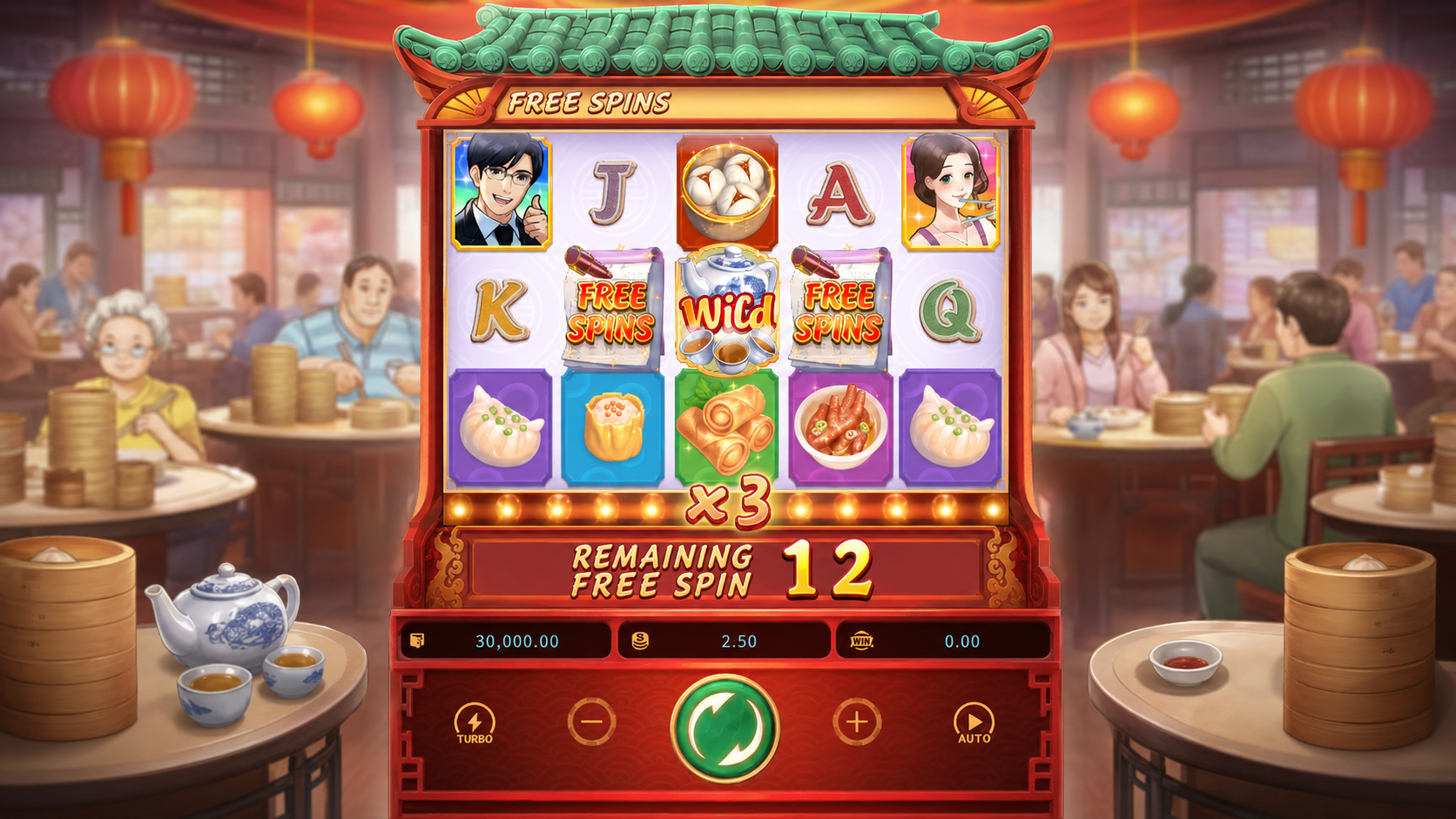
Landing at least three order pads starts 15 Free Spins. Every win during the feature is multiplied by x3. The factor applies across the bonus rather than rising from spin to spin.
There is no paid individual-reel respin in this mode. Each bonus spin resolves as a normal 243-way result, the x3 factor is applied to any win, and the next free spin begins. The removal of the orange price row makes the bonus mechanically simpler than the base game.
Free Spins may be retriggered by another valid Scatter combination. Since the ordinary trigger grants 15 spins, a retrigger creates another batch under the same x3 rule. The multiplier does not climb to x6 after retriggering; it remains x3 on each qualifying win.
The flat multiplier works particularly well with multi-way Wild wins. A teapot on one of the three middle reels may create several routes for the same food symbol. The game totals those ways according to the normal calculation and applies x3 to the resulting bonus win.
The bonus reconstruction above follows the real cabinet, established symbol set and in-game rule stating that all Free Spins wins receive x3. The paid reel buttons are absent because Reel Respin is unavailable during this mode.
The fixed 15-spin length creates a different pace from the base game. There is no decision after every stop, so several spins pass quickly. The x3 marker remains the main point of reference until another Scatter set appears or the counter reaches zero.
Medium volatility does not mean an even session
Dim Sum Mania is rated medium volatility. That classification describes the mathematical distribution relative to lower- and higher-variance designs; it does not turn wins into a steady schedule.
The 243-way grid produces many small symbol routes, while premium characters and multi-way combinations create larger spikes. Free Spins multiply every qualifying award by three. The paid respin layer adds another source of irregularity because two sessions with the same initial reel results may diverge if different extra spins are purchased.
The listed 96.75% RTP is a long-run model value, not a result expected from a short test. It also needs to be read with the feature rules in mind. A respin is another wager with its own displayed cost. Comparing a final cash win only with the original 2.50 spin ignores any extra charges made after the first stop.
For example, a 2.50 base spin followed by respins costing 0.40, 0.73 and 0.32 has used 3.95 in total. A resulting win of 3.00 looks larger than the original base stake but remains below the combined cost of the sequence. The interface shows each charge separately, so the full path needs to be reconstructed from those amounts.
This is not a flaw in the RTP figure. It is a consequence of a game that permits optional paid actions after the base result. Session outcomes depend on both reel randomness and the number of extra wagers added to visible positions.
A secondary Dim Sum Mania database lists a hit rate near 30.36%, but that figure is less useful here without a precise definition of how respin events are counted. The 96.75% RTP and medium-volatility classification are the more consistently published specifications.
How the 20,000x ceiling relates to the paytable
The male diner pays 4,000 paytable units for five consecutive reels, yet the advertised maximum is 20,000x. Those numbers describe different layers of the calculation.
A symbol value is multiplied by bet size, bet level and the number of winning ways. Several copies on one or more reels can create multiple five-reel routes. Simultaneous wins for different symbols are added. Scatter value may also be present on the same screen, and bonus wins receive x3.
The 20,000x figure is therefore a game-level ceiling rather than the value printed beside one symbol. It should not be read as five copies of the male character automatically producing 20,000x. Position count, winning-way count, bet configuration and active mode all matter.
The paytable also shows why five premium symbols are difficult to compare from a static picture. One man on each reel creates one route. Three men on reel one, two on reel two and one on each remaining reel create six five-reel routes. Both screens display the same character across all five columns, but their way counts are different.
During Free Spins, the finished win receives x3. That factor raises the value of dense multi-way screens, though the advertised cap still limits the final award. The x3 does not change the symbol route count; it changes the payout after the normal ways calculation.
A 2020 mobile interface that still makes sense
Dim Sum Mania was built around a portrait cabinet. The green roof sits above the reels, the 5-by-3 grid occupies the centre, and the restaurant counter fills the strip below it. Balance, total bet and win appear above the main spin controls.
The respin prices fit naturally between the grid and counter. Each button is directly beneath the reel it controls, so there is no need to match a menu label with a distant column. This positional mapping is the strongest part of the interface.
The main spin button is large enough for one-handed phone use. Turbo, stake adjustment and autoplay sit around it without covering the paid respin row. A wide desktop monitor simply places scenery around the tall cabinet.
Text size is less consistent. The main balance and bet figures remain readable, but rule pages contain dense paragraphs designed for a long phone screen. The important respin warnings are easy to miss if the help page is only skimmed.
The soundtrack uses light percussion and restaurant ambience rather than a dramatic orchestral score. Wins add short celebratory cues, while the reel-respin buttons use a more immediate click-and-spin sound. Audio supports the timing of the second wager without making every small result feel oversized.
The restaurant theme is specific without becoming a story
The visual setting draws from a Cantonese dim sum restaurant, including bamboo steamers, tea service, green tiled roofing and red lacquer panels. The food icons match the cabinet instead of functioning as unrelated generic symbols.
The title art centres on a large steamed bun being opened with chopsticks. Siu mai and chopped spring onion surround it. The image communicates the subject before the title needs to be read.
There is no narrative progression. The diners do not unlock new scenes, the restaurant does not gain upgrades, and the menu does not change during Free Spins. Theme is used as a consistent frame for the mechanics rather than as a developing plot.
That restraint works because the respin buttons resemble placing another order. Each reel carries its own price, and the player chooses one item from the row. PG Soft did not turn that metaphor into a separate mini-game, but the connection between restaurant bill and reel cost is easy to feel.
Free Spins is visually plainer. The x3 factor and remaining-spin counter replace the pricing decision. The cabinet remains in the same restaurant, so the mode change is functional rather than theatrical.
What the design gets right
Dim Sum Mania attaches its main feature to a screen that already exists. Four reels are preserved, one reel changes, and the effect of the choice is immediately visible. No separate bonus board is needed.
The five prices are mapped clearly to their reels. A selected column does not need an explanation after it starts moving. The game also discloses that price does not equal chance, which prevents a common misunderstanding.
Paying only new combinations is a sensible rule. Without it, a small existing win could be collected repeatedly by moving an irrelevant reel. The restriction keeps the respin focused on creating or extending routes.
The Wild limitation is also well judged. Teapots on reels two, three and four strengthen the middle of a chain, but natural endpoint symbols remain necessary. The Wild helps the ways grid without making five-reel combinations trivial.
Free Spins simplifies the cabinet at the right moment. Fifteen automatic spins with a flat x3 factor create a clear contrast with the decision-heavy base mode. Retriggers extend the same structure instead of adding another rules layer.
Where the second order becomes expensive
Repeated respins can obscure the true cost of one resolved position. The game displays every charge, yet the final win field does not automatically frame the result as original stake plus all optional respins. A sequence may feel successful because it ends with a win even when the combined charges are larger.
The unequal prices may also suggest information they do not contain. The help page warns against this, but that warning is separated from the main reels. Someone who never opens the rules may assume the most expensive reel has stronger odds.
Only new wins are paid, which is mathematically necessary but not visually obvious. Existing symbols remain on screen after a respin, and a glowing route may look as though it has paid again. The distinction is easier to understand from the rule page than from the animation alone.
The base mode can also become slow if every screen is examined as a puzzle. That is the cost of giving the user a post-spin decision. Free Spins removes the pause, but the regular game is less automatic than most 243-way slots.
The theme has charm without much development. Food icons, staff and restaurant decor remain static across a long session. The mechanic carries more personality than the characters do.
Who will understand Dim Sum Mania fastest
The game makes the most sense to someone comfortable reading a 243-way grid from left to right. Recognising how matching-position counts multiply across reels makes the single-reel decision easier to interpret.
It also suits analysis based on visible positions. The initial screen is known before an optional wager is made, and four reels stay frozen. That is different from a blind bonus purchase or an Ante Bet activated before the result exists.
Anyone expecting the respin price to function as an odds quote will misunderstand the feature. The amount is a charge attached to changing one reel, not a prediction printed by the game.
Free Spins requires less interpretation. Three Scatters start 15 spins, all bonus wins receive x3, the feature may retrigger, and paid reel respins are disabled. The bonus is straightforward once the Scatter and Wild restrictions are known.
Final serving
Dim Sum Mania remains interesting because the main feature begins after the normal slot would have finished. The first wager creates a position. Five separate prices then turn that position into a small decision board.
The strongest rule is also the easiest to overlook: only new combinations created by a respin are paid. The second most important rule is that reel price does not indicate win probability. Together, those statements define how the mechanic should be read.
The rest of the design is compact. There are 243 left-to-right ways, a teapot Wild restricted to reels two through four, an anywhere-paying Scatter, 15 retriggerable Free Spins and a flat x3 bonus multiplier. Medium volatility and a 96.75% listed RTP sit beneath an advertised 20,000x ceiling.
PG Soft could have made the restaurant busier with more side systems, but the restrained format keeps attention on the orange buttons below the reels. Dim Sum Mania is not really about ordering as many dishes as possible. It is about deciding if one more reel belongs on the bill.
By Fairy Editorial - 27 Jul 2026

Super Wildrix
Super Wildrix Review: The x100 Wheel Is Powerless Until the Hero Lands
Super Wildrix looks like a superhero slot, yet the cape and casino-city setting are mostly framing. The actual identity sits inside a single symbol: a masked hero who expands over an entire reel and carries an x2 multiplier. That character may appear in the regular game, and the same mechanic becomes far more dangerous in Free Spins when a wheel can raise the multiplier as high as x100.
The important catch is easy to miss. A large wheel result does not create a payout by itself. It needs a Wildrix symbol, and the expanded Wildrix still needs a valid payline win to multiply. This dependency gives the game a sharper rhythm than its loud comic-book presentation suggests. Long patches may pass with ordinary fruit and card symbols, then a hero reel changes several paylines at once.
Released by Pocket Games Soft, usually shortened to PG Soft, Super Wildrix uses a 5-reel, 5-row grid with 25 fixed paylines. The declared RTP is 96.75%, volatility is rated high, and the maximum win is 20,000 times the stake. The official information sheet also lists a 22.03% total hit rate. Those figures describe a slot built around concentrated events rather than a constant stream of meaningful returns. The full specifications are published in the PG Soft game information sheet, while the publisher page identifies the title as game 195 in its catalogue on the official PG Soft website.
A familiar grid with one disruptive symbol
The 5-by-5 arrangement is larger than the old three-row format, but Super Wildrix does not use cluster pays or all-ways evaluation. It keeps 25 fixed lines. A paying combination starts on reel one and runs through adjacent reels from left to right. Three or more matching symbols are normally required, so symbols sitting in the middle or at the far right do nothing unless a valid chain reaches them from the first reel.
This matters because the tall grid can look busier than the pay system really is. Five rows put 25 symbol positions on screen, yet only the marked paths count. A line may zigzag between rows, and the on-screen payline display is more useful here than in a ways slot. The larger grid increases the number of places where the hero may land, but it does not turn every neighbouring match into a prize.
The symbol set mixes casino fruit with superhero decoration. Cherries, grapes, bells, horseshoes and red 77 symbols occupy the reels beside card ranks. A gold badge acts as the Scatter. The ordinary W symbol is the standard Wild, while the full-height hero is the Wildrix. The fruit cabinet is a strange fit for Neonshine City, though it keeps the values readable on a small phone display. PG Soft chose recognition speed over a fully developed comic-book world.
That decision also makes the reels easy to scan. Cherries and grapes are distinct at a glance, the gold Scatter does not blend into the background, and the hero reel is impossible to mistake for a normal symbol. The slot rarely leaves the player wondering which special symbol just landed. Its weakness is thematic depth rather than visual clarity.
Wild and Wildrix are not the same thing
Both Wild types replace every paying symbol except the Scatter, but only Wildrix expands and brings a multiplier. A normal W can finish a line without changing its value. Wildrix fills its entire reel, substitutes across every row and attaches x2 to all wins connected to it.
The expansion occurs after the reels stop. A single hero symbol becomes a full stack, which means the original landing position does not limit its usefulness. If Wildrix lands near the bottom of reel three, the completed hero still occupies all five cells on that reel. Any of the 25 paylines crossing reel three may then use it as a substitute.
Multiple Wildrix reels do not multiply one another in the base game. Their x2 values are added. The official wording states that all wins are multiplied by the total sum of multipliers from the expanded Wildrix symbols. The practical math is:
One expanded Wildrix produces x2.
Two expanded Wildrix symbols produce x4, not x8.
Three expanded Wildrix symbols produce x6, not x12 or x16.
That additive rule keeps the regular game from escalating too rapidly. Two full hero reels can connect many paylines and turn four- or five-symbol matches into much larger results, but the multiplier grows in steady x2 steps. Reviews that describe the base multipliers as multiplying together overstate the mechanic.
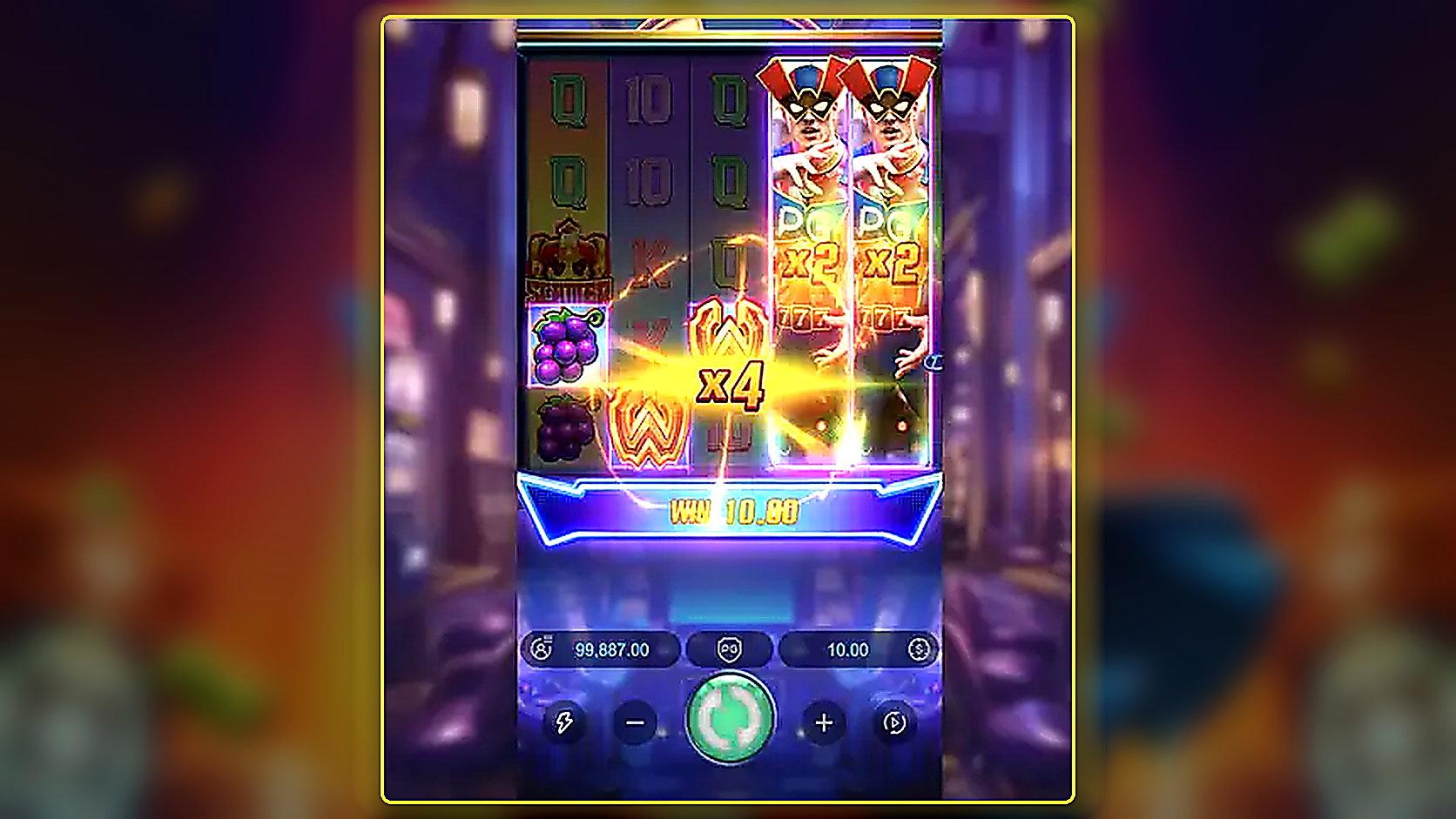
The screen above shows the most useful kind of base-game event. Two hero symbols have expanded on adjacent reels, and the game displays x4. That label confirms the additive calculation. More importantly, the heroes occupy ten symbol positions between them. Their value comes from the combination of full-reel substitution and the multiplier, not from x4 alone.
A Wildrix on reel one is especially efficient because every standard line begins there. A hero on reel five still helps complete four- and five-reel combinations, but it cannot rescue a line already broken on an earlier reel. Location therefore matters even though every Wildrix carries the same printed x2.
The ordinary Wild has a quieter role. It can bridge a missing symbol and preserve a line, but it neither expands nor participates in the Wildrix multiplier total. This distinction is worth checking in the paytable before playing because both symbols use the same angular W branding. The hero portrait and full-reel animation are the clearest signs that the stronger version has landed.
What the base game actually feels like
Super Wildrix runs at high volatility and places much of its theoretical return inside Free Spins. The published component figures assign 58.90% RTP to the main game and 37.87% to the Free Spins section. Those components are rounded separately, so their displayed sum differs slightly from the declared total RTP of 96.75%. The same rounding effect appears in the hit-rate components.
The regular game hit rate is listed at 21.44%. In plain terms, a line result appears on a little more than one spin in five over the mathematical model, but that number says nothing about profit. A small cherry match counts as a hit just as a multi-line Wildrix result does. The figure should not be read as a one-in-five chance of finishing ahead.
Ordinary results are often modest because fixed paylines narrow the routes that count. The tall reel set can show several matching symbols without forming a left-to-right line. That creates visual near-misses that would pay in a cluster or ways game but remain blank here. The payline structure is not unfair; it is simply less permissive than the 25-cell display first implies.
Wildrix landings change the texture immediately. Expansion makes every row on that reel usable, so several paylines may score together. The x2 total then applies after the individual line awards are added. When two heroes land, the x4 label appears across the reels and the result becomes much easier to follow than a stack of separate multiplier notices.
The base game is at its best when Wildrix arrives on reels one through three. Those positions can start or preserve many combinations. A late-reel hero needs useful matching symbols already aligned to its left. This is the central source of tension in regular play: the hero is powerful, but it is not position-proof.
There is no cascade after a win, no collection meter to fill and no persistent multiplier carried from one paid spin to the next. Each result resolves cleanly, then the grid resets. That keeps the pace brisk, though it also means a weak spin has no residual value. Super Wildrix asks the player to wait for a self-contained event rather than build progress across a session.
The wheel is an amplifier, not a prize
Three, four or five Scatter symbols award 10, 15 or 20 Free Spins. The bonus changes the top of the cabinet by adding a multiplier wheel. At the start of every free spin, the wheel selects a value from x2 up to x100. The selected figure then modifies any Wildrix multiplier appearing on that spin.
The order of operations is essential:
- The wheel selects a multiplier.
- Any Wildrix symbol landing on that free spin expands over its reel.
- The base x2 printed on each expanded Wildrix is multiplied by the wheel result.
- If more than one Wildrix expands, the adjusted values are added.
- The resulting total multiplies the qualifying payline wins.
Suppose the wheel stops at x10 and one Wildrix lands. The hero value becomes x20 because x2 multiplied by x10 equals x20. If two Wildrix symbols land on that same spin, each becomes x20 and the two values add to x40. The slot does not calculate x20 times x20.
At the top wheel result, x100 paired with one hero creates x200. Two heroes under the same wheel result become x200 each and combine as x400. The potential is substantial, yet three conditions still need to align: a strong wheel number, at least one Wildrix, and a valid line win. A wheel stopping at x100 without Wildrix has no multiplier to modify. A Wildrix landing without useful symbols to its left may also produce much less than the animation implies.
This design avoids giving the wheel independent cash values. It is not a prize wheel in the usual sense. It is a coefficient generator attached to another random event. A player evaluating a free spin should therefore look at the hero reels before reacting to the number above them.
Ten spins may contain very different amounts of real action
The Free Spins entry hit rate is listed at 0.58% in the official sheet. This is a model figure rather than a promise of a fixed interval. A short session may reach the bonus quickly, while a much longer one may not trigger it at all.
Once inside, every spin gets a wheel result, but not every spin gets Wildrix. That separation produces two layers of suspense. First comes the wheel; then the reels decide if its number matters. A low wheel result can still attach to several hero reels and score well. A high number can pass unused if the hero stays away.
Two Scatters during Free Spins add three more spins. Requiring only two is less demanding than the original three-Scatter entry condition, and repeated extensions are possible. Extra spins have more value here than a simple fixed-spin addition suggests because each one creates another independent wheel-and-Wildrix attempt. They do not raise a persistent meter or retain the previous wheel value; every added spin starts its own calculation.
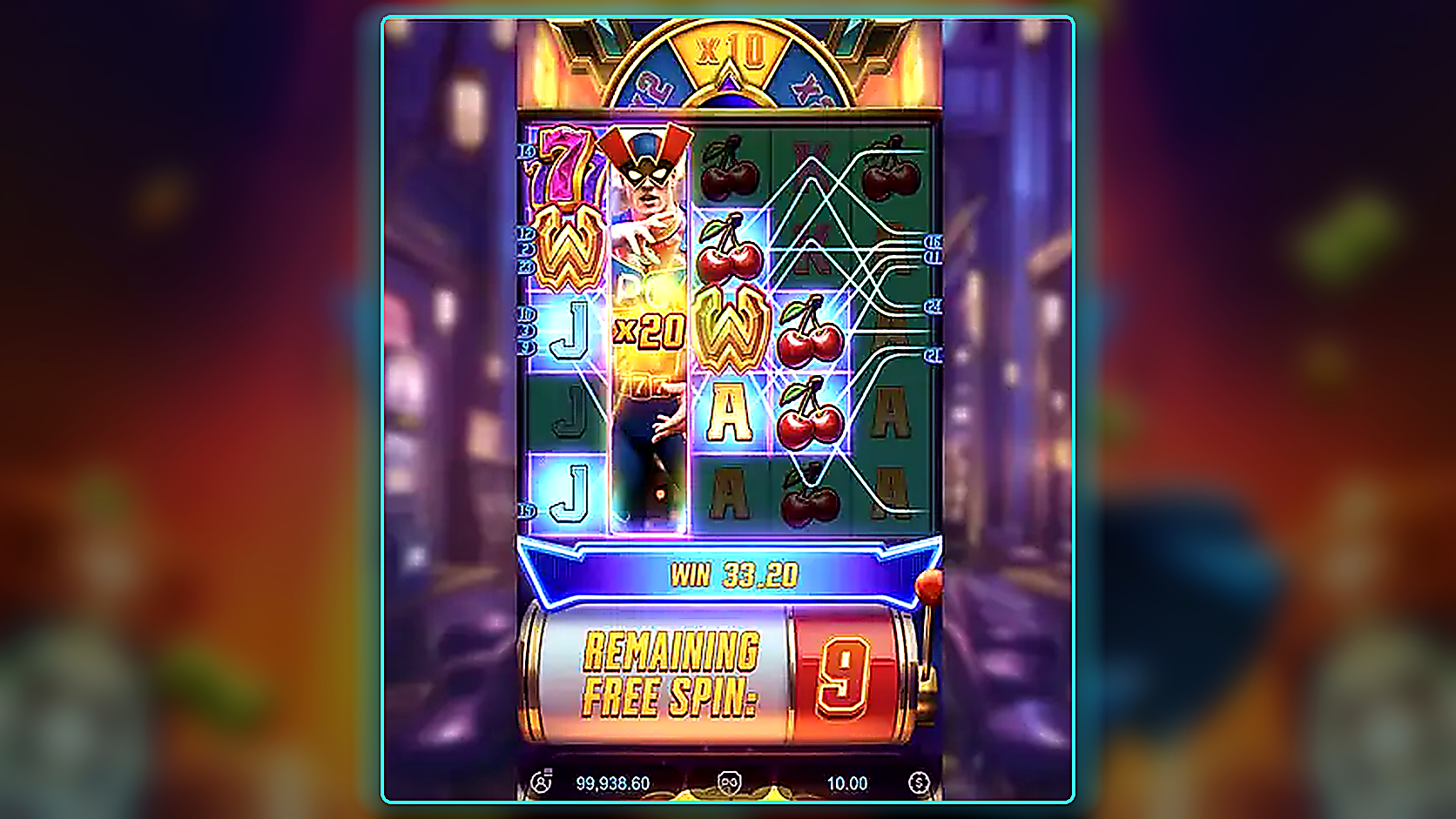
The free-spin image shows the mechanic in a readable state. The wheel has selected x10, while the hero reel displays x20. That is the printed x2 Wildrix multiplied by the current wheel value. The win lines then cross through the expanded reel. The screen demonstrates why the wheel cannot be judged separately from the grid below it.
The bonus also explains the high-volatility label better than the base game does. Most wheel values and reel stops will not form the rare combination needed for an exceptional result. When several elements align, the multiplier can leap far beyond the steady x2, x4 and x6 progression of ordinary spins. The 20,000x ceiling exists to cap those extreme combinations.
Reaching the 20,000x maximum ends the active spin according to the game rules. That figure is maximum exposure, not a typical target. It describes the upper boundary of the model and should not be confused with an expected bonus return.
Reading the 96.75% RTP without dressing it up
The listed RTP is 96.75%. It is a long-run mathematical average calculated across the full game, including the bonus and rare high multipliers. It does not forecast what will happen in a personal session, and a particular operator configuration or market version should always be checked in the live information panel.
The component breakdown is more informative than the headline number. Main-game RTP is shown as 58.90%, while Free Spins account for 37.87%. Separately rounded component values do not match the declared total figure to the last hundredth. That tiny discrepancy is normal in a specification sheet that rounds several calculations.
The split indicates that a large share of theoretical return is tied to a bonus reached on only a small fraction of spins. This concentration supports the high-volatility classification. It also explains why judging the slot from a handful of base spins is unreliable. The model includes infrequent wheel events capable of carrying much more value than an ordinary line hit.
Total hit rate is 22.03%, with 21.44% assigned to the main game and 0.58% to Free Spins entry. Those displayed components again differ from the total by one hundredth after rounding. Hit rate counts winning occurrences, not their size. A 22.03% figure can coexist with long losing runs, clusters of tiny hits and rare large outcomes.
The default specification lists a stake range from €0.25 to €100. Peso-facing casinos may convert or configure that range differently, so the figure on the local bet panel is the one that applies. The mathematical limits do not imply that every Philippine-facing operator will display the same minimum, maximum or feature price.
Ante Bet changes more than the button colour
An Ante Bet option raises the stake to ten times the selected base amount and guarantees at least one Wildrix on every paid spin. Industry coverage of the launch also states that the guarantee carries into Free Spins. The mechanic is described in the PG Soft launch report from EE Gaming and the release summary from iGamingExpress.
Ten times the stake is not a small fee attached to the same spin. It creates a materially different cost structure. At a displayed base bet of 1, the Ante version costs 10. The guaranteed hero makes every reel stop more active because a full-reel substitute and at least x2 are already present, but the result must be compared with the tenfold amount risked.
The guarantee also changes the Free Spins wheel. In the normal mode, the wheel may produce a large number that never connects with Wildrix. Under Ante Bet, at least one hero is present, so every bonus spin has a multiplier target. That removes one layer of dependency, though it does not guarantee a profitable line. The hero still needs symbols arranged into one of the 25 paths.
It would be misleading to call Ante Bet a simple improvement. It buys certainty around the signature symbol at a steep price. The relevant comparison is return relative to the enlarged stake, not the raw number flashing after a win. A payout that looks larger may represent a smaller multiple of the amount actually committed.
Feature Buy shortens the wait, not the mathematics
Where enabled, Feature Buy opens a menu that sells direct access to Free Spins at the price displayed in the game. PG Soft does not state a single universal purchase cost in the general information sheet, so a fixed number should not be copied from another casino. Jurisdiction, operator settings and currency presentation may change availability or pricing.
Buying the bonus skips the base-game route to three or more Scatters. It does not remove the two-part dependence inside Free Spins. The wheel still needs Wildrix, the hero still needs a valid line, and the 20,000x cap still applies. A purchased round may finish with modest value despite showing several large wheel numbers.
This mode is best understood as a route selector. It concentrates the session around the mechanic responsible for 37.87% of the published RTP, but it also compresses the cost into one decision. The bonus itself does not become more generous merely because it was purchased.
Neonshine City looks better in motion than in the symbol list
The setting is called Neonshine City, with a masked casino hero charging into the Crystal Casino. Pink, blue and gold lighting place the action somewhere between a comic-book arcade and a late-night gaming floor. The presentation is loud, but the central reel area remains legible.
Wildrix carries most of the personality. His portrait stretches vertically when he expands, electric light traces the reel edges and the multiplier appears across the centre. The animation makes a mechanical fact clear: this is a full-reel substitute, not a large portrait sitting in one cell.
The Free Spins cabinet is more successful than the base screen. The wheel occupies the space above the reels without shrinking the symbols beyond recognition. Its result remains visible while the hero expands, making the x2-by-wheel calculation easy to verify. The remaining-spin counter sits below the grid and does not cover the payline display.
The soundtrack and win effects lean into arcade heroics, with sharp electrical cues around Wildrix and heavier fanfare for larger totals. They are tightly timed rather than drawn out. Regular losses clear quickly, which suits a game that may need many attempts before its central combination appears.
The generic fruit symbols are the visual compromise. They make the game instantly readable, but they do little to develop the superhero premise. A deeper comic cast, villains or city-specific objects could have made the world more memorable. As it stands, the theme is concentrated in the hero, the logo and the bonus cabinet.
Built for a phone held upright
PG Soft lists an optimal 1080-by-2340 display with a 19.5:9 ratio. That specification explains the tall cabinet and the generous vertical spacing around the reels. The interface was designed for portrait mobile play first, not squeezed down from a desktop landscape layout.
On a phone, the spin button and stake controls sit within easy thumb reach below the grid. Balance, current bet and win total remain separated. The information menu houses the paytable, rules, RTP and control explanations, so the main screen avoids permanent text blocks.
Landscape desktop displays place blurred casino scenery around the narrow cabinet. The side space is decorative; it does not contain extra reels. This can make the game look smaller on a wide monitor, but it preserves the portrait proportions and keeps every control in the intended position.
Philippine mobile users should find the layout familiar because PG Soft has used a similar portrait-first shell across much of its catalogue. Performance still depends on the casino client and connection, but the visual hierarchy is sensible for one-handed use. The wheel, hero multiplier and remaining-spin count are readable without opening a secondary panel.
Where Super Wildrix gets the math right
The strongest part of Super Wildrix is the relationship between symbol coverage and multiplier value. An expanding Wild is already useful on a 5-row grid. Attaching x2 makes the event matter without turning every base-game appearance into an absurd number. Adding multiple heroes rather than compounding them preserves clarity.
Free Spins then change the scale without rewriting the rule. The wheel multiplies each hero value, and multiple adjusted hero values are still added. The same logic governs both modes, so the bonus feels like a powered-up version of the base game rather than an unrelated side activity.
The rules are also inspectable on screen. Two base-game heroes display x4. An x10 wheel beside one hero displays x20. A player does not need to infer a hidden formula from the final cash amount. This transparency is valuable in a slot with several multiplication stages.
Retriggers fit the structure well. Two Scatters add three spins, creating more wheel attempts without introducing a second bonus mode. The slot remains focused on its central mechanic from the opening spin to the maximum-win scenario.
Where the cape starts to drag
The same focus can become repetitive. Outside Wildrix and Free Spins, little changes. There are no cascading symbols, persistent upgrades, roaming reels or collection goals. Base spins without the hero resemble a conventional 25-line fruit slot dressed in neon.
The wheel presentation may also exaggerate weak spins. Seeing x50 or x100 creates an immediate expectation, but the number is inert without Wildrix. Even when the hero lands, a broken left-to-right path can leave the result far below the visual promise. That is mathematically coherent, though it can feel anticlimactic.
High volatility and a bonus-heavy RTP split make short tests especially noisy. A demo run with no Free Spins misses a large part of the model. A lucky bonus with an early x100 hero may create the opposite impression. Neither sample reveals the long-run distribution.
The superhero story never moves beyond its opening premise. Wildrix does not fight an enemy, rescue a character or change form as the session develops. Anyone drawn by the comic-book artwork may find a mechanically clear slot rather than a narrative one.
Ante Bet raises another point of caution in interpretation. A guaranteed Wildrix sounds decisive, yet the cost is ten times the base stake. Raw wins become visually larger, which makes comparisons across modes difficult unless everything is converted back to stake multiples.
Final assessment
Super Wildrix is a compact multiplier slot with a correctly defined hierarchy. Fixed paylines determine the win, full-reel heroes improve coverage, hero values add together, and the Free Spins wheel scales each hero before that addition. Once those steps are understood, the game becomes much less mysterious.
Its best moments come from overlap: two expanded heroes supporting several paylines in the base game, or a high wheel result attaching to a hero during Free Spins. The wheel alone is only decoration with a number on it. Wildrix alone is useful but controlled. The combination is where the 20,000x ceiling becomes relevant.
The published 96.75% RTP is respectable on paper, while the 58.90% main-game component and 37.87% Free Spins component reveal how much weight sits behind the bonus door. A 22.03% hit rate does not soften the high-volatility profile because many counted hits are small and the rare multiplier chains carry disproportionate value.
PG Soft has kept the rule set narrow and readable. That restraint helps the math, yet it leaves the base game exposed when the hero is absent. Super Wildrix works best for someone interested in one strong mechanic studied across two modes, not for someone expecting a long list of side systems.
The final verdict is straightforward: the x100 wheel is not the star by itself. The star is the expanded Wildrix reel, and the wheel only decides how much power that hero receives. That dependency gives the slot its tension, its dry spells and its largest possible swings.
By Fairy Editorial - 27 Jul 2026

Zombie Blasters
Zombie Blasters Review: One Alarm Can Turn a Pixel Horde Into a Multiplier Ambush
Zombie Blasters puts an arcade cabinet in the middle of a ruined street and treats every spin like another coin dropped into the machine. A block-headed zombie charges from the left. A heavily armed survivor fills the opposite side of the screen. Between them sits a narrow reel cabinet with a red button, an alarm lamp, and a multiplier wheel mounted above the grid.
The shooter theme is mostly presentation. There is no aiming system, health bar, ammunition counter, or character upgrade tree. The real fight takes place inside a 30-cell Scatter Pays board where groups explode, replacement symbols fall, and multipliers wait for a winning result before becoming valuable.
That distinction helps explain the game quickly. Zombie Blasters is not a shooter converted into a slot. It is a high-volatility multiplier slot dressed like a late-night arcade machine. The gunfire, alarm lights, and voxel zombies give the math a personality, but the session is decided by cluster size, cascade length, multiplier timing, and the number of spins left after the bonus meter starts growing.
PG Soft released the title in June 2026. The studio describes it as a 5 by 6 symbol slot, while the visible screen is most naturally read as six columns across and five rows down. Either description points to the same 30 positions. The official PG Soft game information sheet confirms a 96.75% RTP, high session volatility, a 24.81% hit rate, collapsing reels, and a maximum result of 10,000 times the stake.
Cabinet specifications
Developer: Pocket Games Soft, commonly shown as PG Soft
Release period: June 2026
Grid: 30 positions in a 5 by 6 arrangement
Pay method: Scatter Pays
Minimum matching-symbol count: 8
Reel action: winning symbols disappear and replacement symbols fall
Published RTP: 96.75%
Published hit rate: 24.81%
Session volatility: High
Maximum win: 10,000 times the bet
Standard multipliers: x2 symbols
Wheel range: x5 to x50
Free Spins entry: 4, 5, or 6 or more Scatter symbols
Default stake range in the official sheet: €0.20 to €100
Feature Buy: direct Free Spins entry at the locally displayed price
The numbers point to a slot that does not need constant visual complexity. Its payout model depends on a few mechanisms interacting at the right time. An ordinary cluster starts a reaction. The reaction may expose another cluster. Multiplier symbols then affect the combined result. An Alarm can replace every active multiplier with a much larger wheel value. Free Spins retain multiplier value for later rounds.
The difference between an unremarkable spin and a major result is therefore not always visible on the first grid. Much of the value may arrive after the first winning group disappears.
Thirty cells with no paylines to trace
Zombie Blasters ignores traditional left-to-right paylines. Eight or more matching symbols anywhere on the board create a payout. The symbols do not need to begin on the first reel, and the game is not asking the eye to follow diagonal lines through the cabinet.
This makes the opening read of a spin unusually direct. Count repeated symbols across all 30 positions. A group of seven misses. A group of eight pays. Larger groups reach higher paytable tiers.
The system is sometimes called Cluster Pays on casino pages, but Scatter Pays is the more precise description here. A cluster system normally requires matching symbols to touch horizontally or vertically. Zombie Blasters counts identical symbols anywhere on the grid. Two matching icons on opposite corners still contribute to the same total.
That rule changes how crowded boards should be interpreted. A screen filled with the heroine symbol may pay even when the characters are separated by letters, knives, and pistols. Position matters less than quantity until special symbols enter the calculation.
The lower-value set uses 10, J, Q, K, and A. The premium side consists of a knife, pistol, zombie, and the red-haired heroine. Their chunky outlines are more than a stylistic choice. PG Soft built the title around a portrait-oriented cabinet, so every symbol needs to remain readable when the playable grid occupies only the middle portion of a wide display.
The heroine and zombie are especially easy to count because their faces create strong blocks of red, green, and skin tone. Weapons are slimmer and can disappear visually among letter symbols during a fast drop. Slowing down is not required for the rules, but the contrast difference explains why character-heavy boards feel more immediately promising.
A winning board is only the first frame
Once eight or more matching symbols pay, those symbols are removed. Everything above the empty spaces falls, new symbols enter from the top, and the game checks the board again. Another qualifying group starts another reaction within the same paid spin.
The chain ends only when the replacement board contains no new win. All wins produced during the reaction belong to the same spin cycle, which becomes important when multipliers are applied.
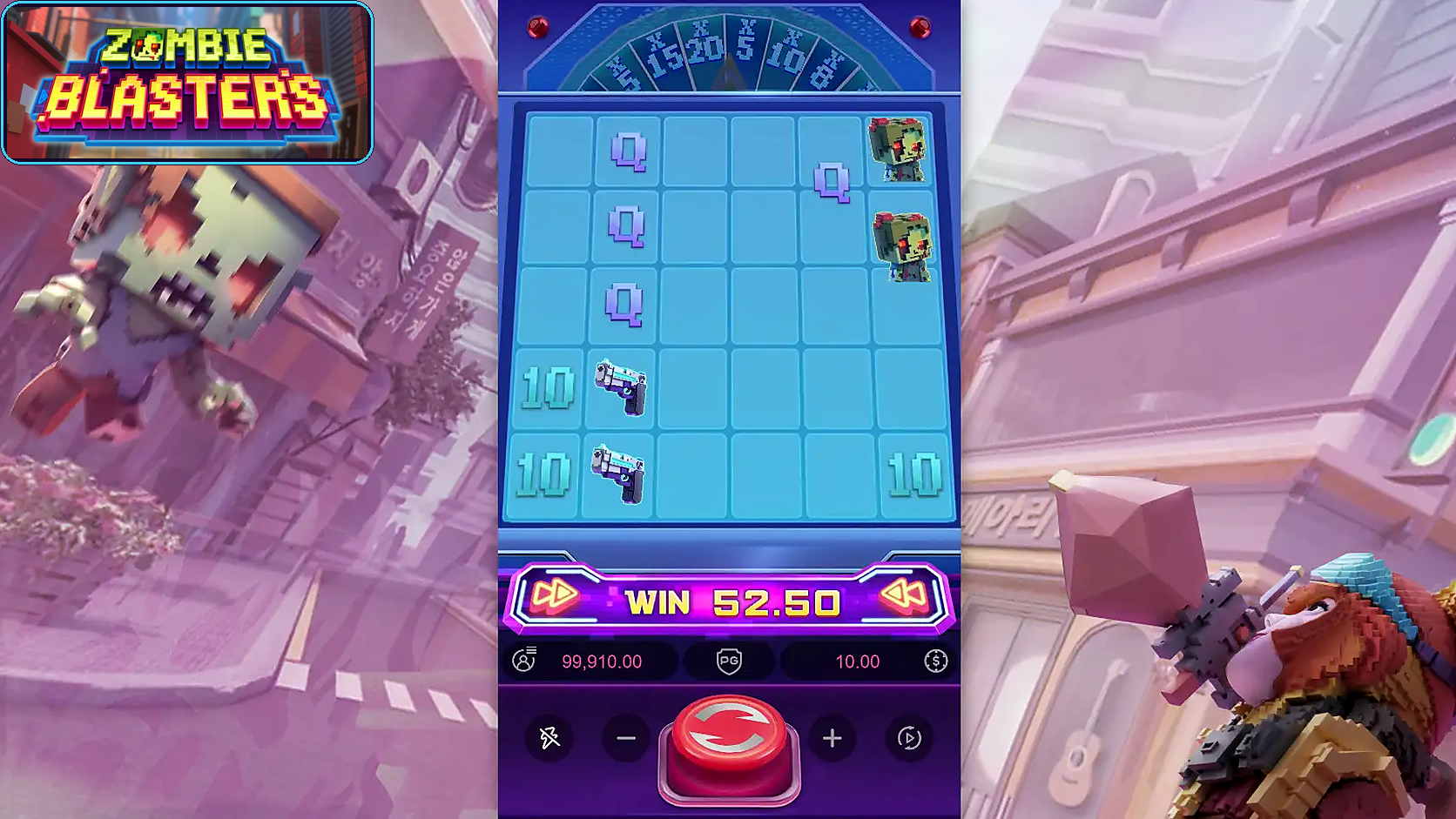
The third image in this review shows the aftermath of a successful reaction. Most of the grid has been cleared, only a few symbols remain, and the win counter displays 52.50. A normal reel slot would have settled as soon as the first symbols stopped. Here, the empty spaces are evidence that the original outcome developed into something larger.
Cascades create two separate paths to a stronger spin. The first is simple accumulation: several small wins add together. The second is board renewal: removing a large number of symbols makes room for a fresh set, including multiplier or Alarm symbols that were not present at the start.
Long reactions are not automatically profitable. A chain can consist of low-value letter groups and finish without a multiplier. At the same time, a modest cluster can become the opening needed for an Alarm and several multiplier symbols to share the final board. The number of cascades matters, but the symbols remaining when the reaction settles matter more.
The game does a good job of keeping this sequence readable. Winning icons flash, vanish in square bursts, and leave a clean blue field behind. Replacement pieces drop in straight columns. The animation is quick enough to preserve the arcade rhythm without hiding which group caused the next step.
The x2 tiles are dormant until the spin pays
Standard multiplier symbols carry x2. They are not regular paying symbols, so a screen full of multipliers without a qualifying symbol group does not create a win by itself.
When the spin has a payout, visible multiplier values are added. One x2 tile turns the result into x2. Two x2 tiles create x4 rather than x2 multiplied by x2. Three create x6. The arithmetic is additive before it is applied to the accumulated spin win.
This distinction prevents a common misreading. Three x2 symbols do not make x8. Their printed values are combined into six, then that combined figure multiplies the relevant total.
The position of a multiplier is less important than its survival on the board at settlement. It does not have to sit inside the paying symbol group. That makes cascades useful even when the replacement symbols fail to create a huge cluster. A reaction may clear space, leave several x2 tiles visible, and build a respectable multiplier around an otherwise ordinary payout.
The weakness of the base system is equally clear. Multipliers can appear on dead spins. Seeing two x2 tiles on a board that does not contain eight matching symbols creates no consolation return. The game regularly shows the ingredients of a stronger result without supplying the qualifying win needed to activate them.
That near-miss language fits the high-volatility model. The board can look loaded while paying nothing, then a later spin uses fewer symbols far more effectively because one cluster keeps the calculation alive.
The red Alarm is where the math changes gear
The Alarm symbol connects the grid to the wheel above it. During a winning spin, an active Alarm triggers the Multiplier Wheel. The wheel selects a value from x5 to x50.
The selected number does more than add a single multiplier. The Alarm and every multiplier symbol currently present on the reels transform into the wheel value. Their values are then combined before multiplying the spin win.
Consider a board containing one Alarm and two ordinary x2 tiles. If the wheel stops at x20, all three become x20. Their combined value is x60. The strength of the wheel therefore depends on both the selected segment and the number of symbols being upgraded.
This is the central calculation in Zombie Blasters. A high wheel result attached to one symbol can be useful. A medium wheel result copied across several symbols can be much stronger. Counting the multiplier positions before the wheel stops gives a better sense of the possible outcome than staring only at the pointer.
The official material sets the wheel range at x5 to x50. The upper end is not required for a serious payout. If four symbols are changed to x15, the combined result is already x60. The game gains much of its top-end force through duplication rather than a single enormous printed multiplier.
Alarm timing also matters. It must coexist with a winning spin. An Alarm arriving after a cascade has failed to create eight matching symbols cannot rescue the board. In contrast, an ordinary low-tier cluster can become valuable because it gives the Alarm a valid event on which to act.
The relationship between cluster and Alarm is more interesting than the shooter artwork suggests. The cluster is the ignition. The wheel chooses the replacement value. The number of Alarm and multiplier tiles controls how widely that value is copied. The final spin win supplies the amount being multiplied. Four separate pieces must align.
Free Spins remember what the base game forgets
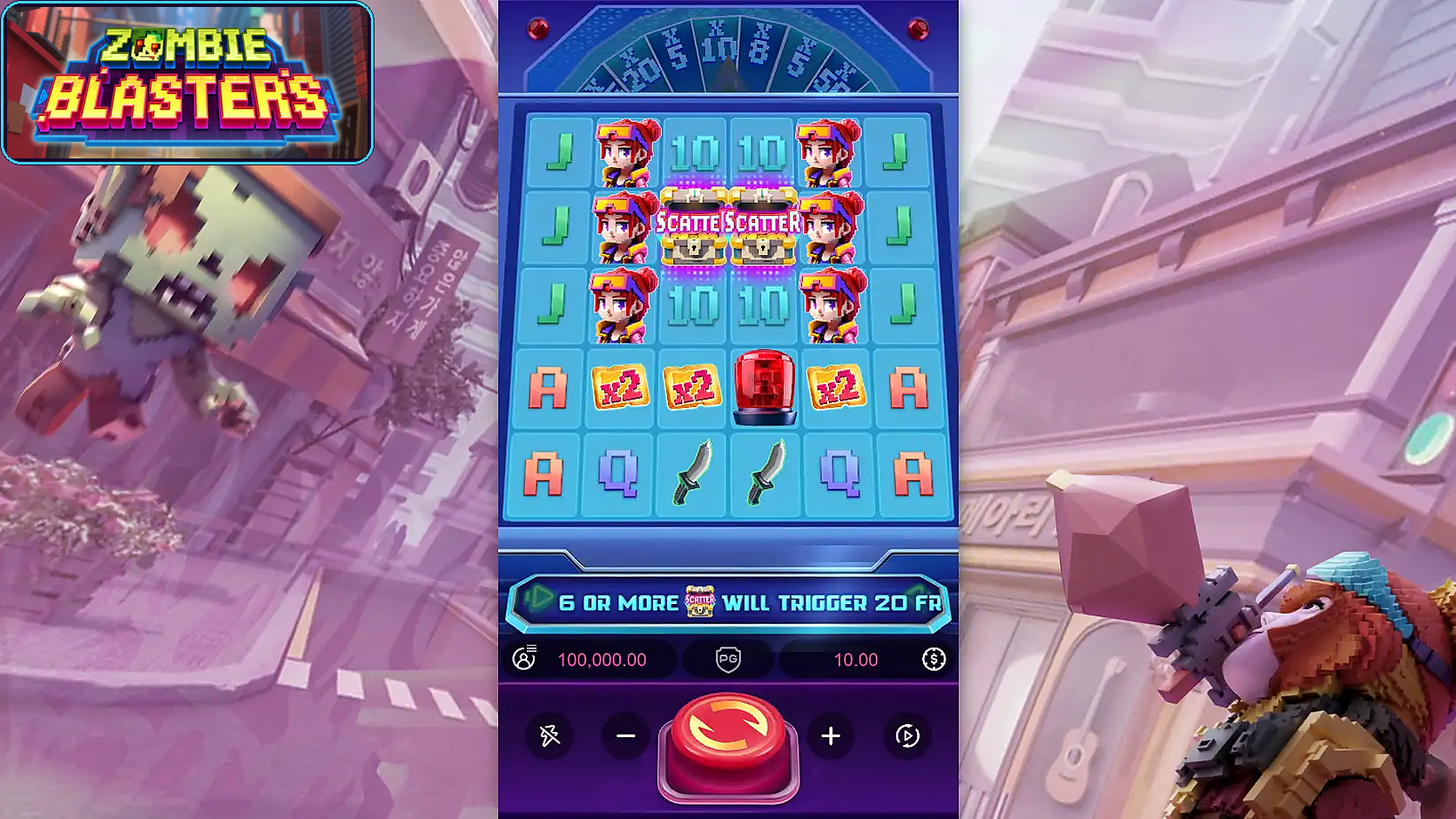
Four Scatters award 10 free spins. Five award 15. Six or more award 20. The trigger image above shows several heroine symbols, two Scatter chests, three x2 tiles, and an Alarm sharing the same board, illustrating how busy the transition can become before the bonus begins.
The main change inside Free Spins is memory. Multipliers collected during the round move into a pot beneath the reels and remain there until the bonus ends. New values raise the stored total instead of disappearing after one spin.
That turns the bonus into a progression system. Early spins establish the multiplier bank. Later spins apply a larger retained value. A multiplier collected on spin one has more future opportunities to matter than the same multiplier collected on the last spin.
The running pot works alongside multipliers visible on the current grid. At settlement, the game takes the stored value and the active reel multipliers into account before paying the free-spin win. An Alarm can sharply increase the current contribution because it replaces active multiplier symbols with the wheel result.
This produces several distinct bonus shapes.
A quiet round may collect little during the first half and leave the pot too small to transform ordinary clusters. Another may find several x2 symbols early, allowing even medium-sized groups to pay more heavily later. The strongest route adds an Alarm after multiple multiplier positions have appeared, pushing the current result and the stored progression upward while enough spins remain to use it.
Three or more additional Scatters during Free Spins add five spins. The stored multiplier remains in place. Retriggers are therefore more valuable late in a developed bonus than they would be in a mode where every spin resets.
Five extra rounds at a weak stored value mainly increase the number of attempts. Five extra rounds after the pot has grown give that accumulated value five more chances to meet a paying group. The retrigger does not merely extend the timer; it extends the useful life of everything already collected.
The bonus is still capable of finishing with a disappointing return. Persistent multipliers cannot create wins on their own. A large stored number needs clusters, and those clusters need at least eight matching symbols. The pot can look impressive while the board repeatedly lands groups of six or seven.
This tension keeps the bonus from becoming an automatic payout escalator. Progress is visible, but visible progress does not guarantee that the final spins will use it.
The 96.75% RTP is split more sharply than the headline suggests
The official information sheet breaks the 96.75% theoretical return into 65.09% assigned to the main game and 31.66% assigned to the Free Spins feature. Those components add to the published total.
This split says more about the design than a generic statement about RTP. Roughly one-third of the theoretical value sits in the bonus portion. The base game still carries most of the return, but a substantial share depends on entering and resolving Free Spins.
The published hit rate is 24.81%. The same sheet lists 24.38% for the main game and 0.44% for the Free Spins feature line. The small rounding difference is normal in summary data. The 0.44% figure should not be read as the chance that an individual free spin wins. It belongs to the feature component of the game-level hit-rate breakdown.
A hit rate near one result in four sounds active until win size is considered. A low-tier eight-symbol group counts as a hit. It may return less than the stake, especially without a multiplier. The statistic measures paid events, not profitable rounds.
High volatility describes the distribution more honestly. Value can gather around long cascades, copied wheel multipliers, and a Free Spins pot built early enough to work across several rounds. Ordinary hits keep the cabinet moving, while the rarer alignments decide the larger swings.
The 10,000x ceiling is enforced in both the main game and Free Spins. If a running result reaches the cap, the spin ends and the maximum amount is awarded. Further cascades or multiplier development are no longer needed once that point is reached.
This cap suits the multiplier structure. A wheel value can be copied across multiple positions, and the stored bonus pot may already be large. Without a firm stop, a rare board could compound beyond the intended exposure very quickly.
Feature Buy removes the wait, not the variance
The Feature Buy button opens a purchase menu where Free Spins may be started at the displayed price. PG Soft does not state a universal cost multiplier in the public information sheet, so a fixed figure should not be copied across casinos. Currency, operator configuration, certification, and local rules may affect what appears.
Buying the feature skips the natural Scatter trigger. It does not select an Alarm result, preload the multiplier pot, guarantee a retrigger, or change the need for eight matching symbols.
That makes the purchase a change in access rather than a change in the bonus rules. The same weak and strong bonus shapes remain possible. A round may build its pot early, late, or barely at all.
Some markets disable feature purchases. An absent button usually reflects jurisdiction or casino settings. It does not mean the base game is missing part of its normal cascade or multiplier logic.
The mobile-first cabinet looks strange on a desktop for a reason
PG Soft lists 1080 by 2340 at a 19.5 to 9 aspect ratio as the optimal display target. That is a tall phone screen. The desktop presentation keeps the narrow cabinet in the middle and fills the unused sides with the zombie and survivor artwork.
This layout has practical benefits. The six-column board remains large enough to read on a phone. The wheel sits directly above it. The win panel, balance, stake, and oversized red spin button form a vertical sequence beneath it. A thumb can reach the main control without covering the symbol area.
On a wide monitor, the central machine may look cramped compared with a slot designed natively for landscape play. The side characters occupy more area than the playable grid. That is not an accidental crop; it is the consequence of placing a portrait mobile interface inside a widescreen frame.
The arcade style handles this compromise better than many mobile-first slots. The narrow playable area resembles a physical cabinet, so the unused width reads as part of the room around the machine. The large zombie on the left and armed survivor on the right create a visual standoff across the central reels.
Pixel and voxel styling also reduces the horror tone. The undead look like toy blocks, weapons resemble arcade pickups, and explosions break into squares rather than blood. The game is about an apocalypse, but it behaves more like a bright cabinet shooter than a grim survival story.
The sound design follows the same direction. Synth pulses mark the reel drop. Clipped electronic bursts accompany disappearing symbols. The Alarm introduces a sharper siren before the wheel spins. Larger results use arcade score-counting sounds rather than orchestral fanfare.
There is enough audio information to separate the stages of a reaction. A player can hear the initial hit, the collapse, a new group, the Alarm, and the final multiplier calculation as different events. Repeated sessions may make the short loops feel mechanical, but the sound rarely obscures what the board is doing.
What the game gets right
The multiplier system has a clear chain of cause and effect. A paying symbol group starts the sequence. Cascades add more results. Standard x2 tiles raise the total. The Alarm wheel replaces several multipliers at once. Free Spins retain value for later rounds. Each layer builds on the previous one.
The wheel also avoids relying entirely on one lucky pointer position. Symbol quantity can compensate for a medium result. Three transformed x15 tiles create more force than one x30 tile. That gives the board state a meaningful role after the wheel has been triggered.
Scatter Pays works well with the portrait grid. The player counts icons rather than tracing small lines across a narrow phone display. The minimum of eight is easy to remember, and the disappearance of winning symbols makes each cascade visually obvious.
The 96.75% RTP is strong for a contemporary high-volatility release. More importantly, PG Soft publishes a detailed split between base-game and bonus return, along with the hit-rate breakdown. Those figures make the payout model easier to discuss without inventing conclusions from a short demo session.
The art has a specific identity. Blocky zombies, a bright blue cabinet, a physical red spin button, and the oversized wheel are recognizable even when the logo is absent.
Where the cabinet starts to creak
The base cycle can become repetitive when the Alarm stays away. Scatter Pays and collapses are familiar mechanics, and x2 tiles do little on a non-winning board. Several spins may display multipliers without turning them into money.
There is also less thematic interaction than the title implies. Zombies do not attack the grid. Weapons do not remove symbols. The heroine does not fire when a pistol group lands. Most action language comes from animation and sound rather than a combat rule.
The portrait layout is efficient on mobile but visually narrow on desktop. Anyone expecting the reels to fill a widescreen display may be surprised by how much space belongs to the background characters.
Free Spins depend heavily on timing. A large multiplier pot reached near the end may have almost no chance to act. A retrigger before the pot has grown adds attempts but does not carry the same weight as five extra spins after a strong Alarm sequence.
Finally, the wheel can create impressive theoretical setups that never meet a worthwhile base win. A copied x30 value looks formidable, yet the multiplier still acts on the accumulated amount created by that spin. Multiplying a tiny cluster does not automatically produce a major payout.
Last round at the cabinet
Zombie Blasters is strongest when a simple Scatter Pays result develops in stages. Eight symbols start the hit. The board clears. New pieces fall. x2 tiles remain. The Alarm flashes. A wheel number is copied across several positions. What looked like a small cluster becomes a calculation involving the entire reaction.
Free Spins give that calculation memory. Stored multipliers turn early collection into later leverage, and retriggers extend the life of the bank already built. The round has a beginning, middle, and end even though the underlying action never leaves the same 30-cell cabinet.
The 96.75% RTP and 10,000x ceiling are attractive headline figures, but the 24.81% hit rate and high-volatility classification describe the actual rhythm more clearly. Paid groups appear with some regularity; high-value combinations depend on longer chains, useful multiplier timing, and bonus development.
The shooter wrapper should not be mistaken for mechanical depth outside the reels. This is still a focused cascade-and-multiplier slot. Its achievement is making that familiar structure easy to read and giving the Alarm wheel a real mathematical purpose.
Zombie Blasters fits readers who enjoy watching one paid spin evolve through several calculations and who prefer a visible multiplier progression over hidden mystery prizes. It is less convincing for anyone expecting constant combat, a large desktop grid, or bonuses that begin with guaranteed strength.
The cabinet does not need to simulate a full zombie war. It only needs one valid cluster, several multiplier positions, and an Alarm at the right moment. When those pieces share the board, the pixel apocalypse finally earns its name.
By Fairy Editorial - 27 Jul 2026
J Mania Triple Jam
J Mania Triple Jam Review: Three Jars, Three Bonuses, and a 3x3 Grid With Teeth
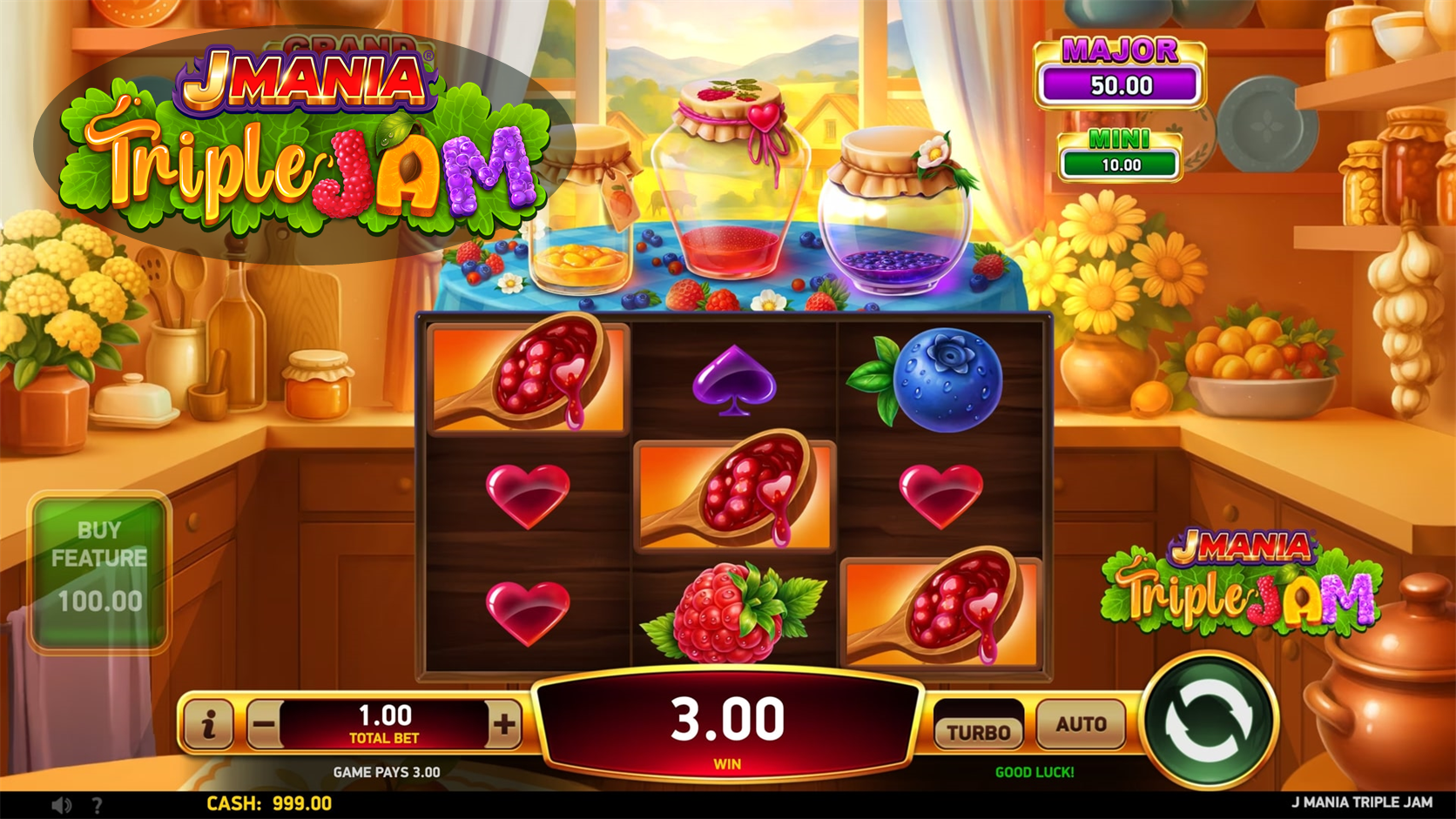
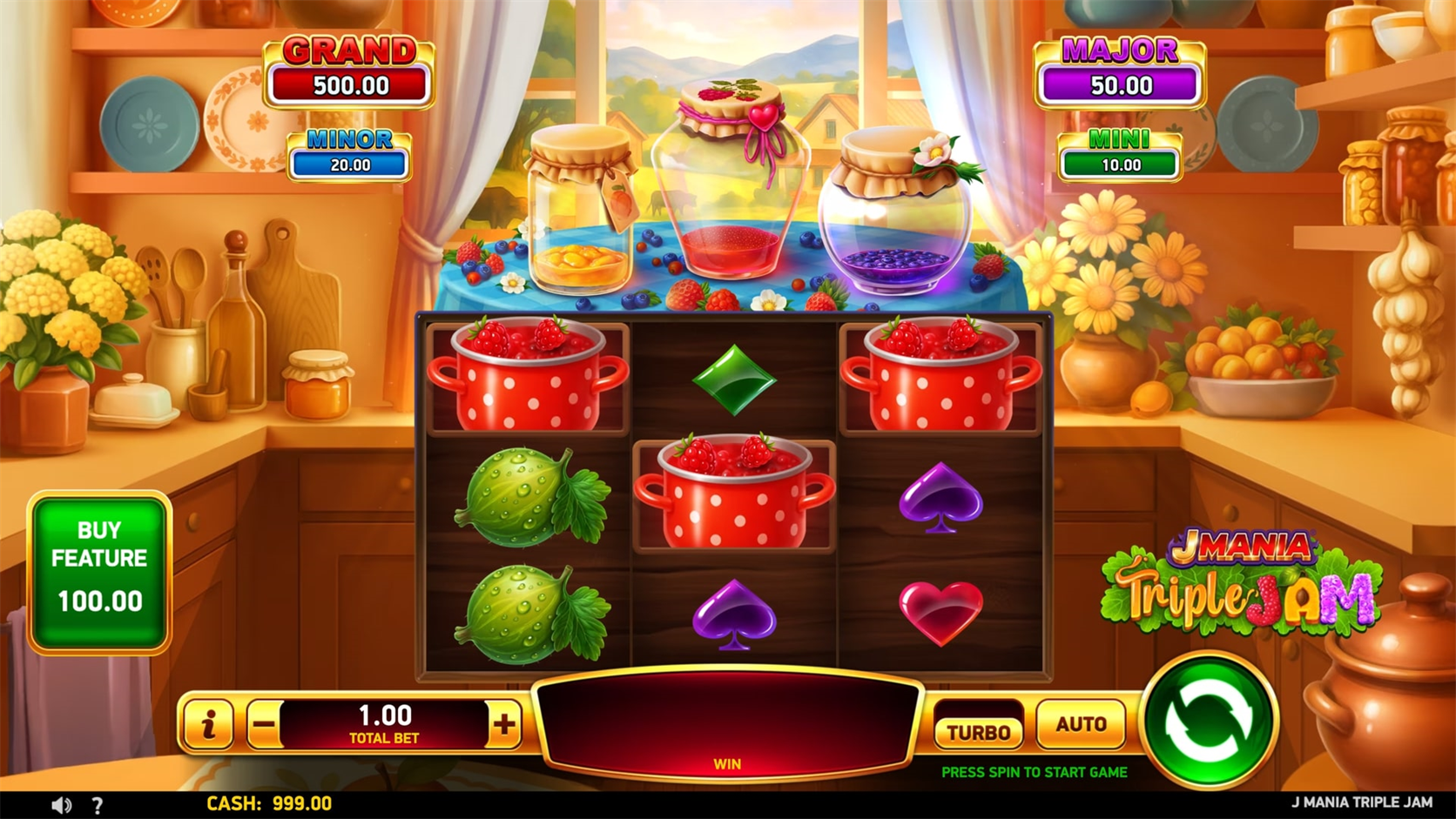
J Mania Triple Jam looks almost too small to carry a serious bonus system. There are only three reels, three rows, and 27 ways to win. The screen resembles a sunny country kitchen rather than a high-pressure casino floor. Jam pots sit beside berries and playing-card suits, while four jackpot meters hang above the reels like handwritten prices at a farm shop.
Then the center square starts to matter.
That single position becomes a sticky Wild in one mode and a collecting jar in another. A separate pick round can award one of four jackpots. A special Trigger Chance symbol may open any of those three routes without waiting for a standard scatter combination. The result is a compact slot whose real structure is hidden behind an unusually plain 3x3 layout.
Some casino lobbies place the title inside a PT or Playtech category. The official product page identifies RubyPlay as the developer, so this review treats PT as a lobby or aggregation label rather than the studio credit. That distinction matters because the rules, statistics, and artwork below come from RubyPlay material.
The numbers before the jam starts boiling
Developer: RubyPlay
Lobby label seen on some platforms: PT or Playtech category
Layout: 3 reels and 3 rows
Win system: 27 ways
Published RTP: 96.36%
Volatility: High
Published hit frequency: 37%
Maximum win: 5,000 times the stake
Main modes: Free Games, J Mania, and Jackpot Pick
Bonus purchase: 100 times the current total bet where the option is enabled
Those figures describe a slot with two very different faces. The 37% hit frequency suggests that some result appears fairly often, yet the high-volatility label and 5,000x ceiling point to a payout curve that is far less gentle than the small grid implies. Frequent contact with a win is not the same as frequent profit. A low-value three-symbol route can count as a hit while doing little to repair several empty spins.
The listed 96.36% RTP is the long-run mathematical setting published for the game. It does not predict the return of a short session, and a casino may run an approved configuration that differs from the headline version. The local information panel is the right place to confirm the active figure before wagering.
Nine positions, twenty-seven routes
The base screen uses all nine positions efficiently. Each reel has three possible landing spots, creating 3 x 3 x 3, or 27, possible routes across the grid. There are no sprawling reel sets and no need to trace a web of printed paylines. The result is immediately readable: matching symbols across the reels settle the spin, the central win panel updates, and the board clears for the next result.
The symbol set fits the kitchen theme without becoming visually noisy. Hearts, spades, and diamond-shaped pieces occupy the lower end. Gooseberries, blueberries, raspberries, jam spoons, and red cooking pots carry more visual weight. The top symbols are large enough to recognize on a phone, which is especially important on a 3x3 slot because every position must remain distinct at a glance.
Base-game wins are not the central reason to study this title. Their job is rhythm. Small combinations keep the compact machine moving while the feature symbols decide when the structure changes. That separation is easy to feel: ordinary spins resolve quickly, but a trigger can replace the kitchen with an orchard, change the purpose of the middle cell, or move into a pick screen.
The minimal reel count also makes misses look blunt. On a larger grid, near-matches can be scattered across several columns and partially hidden by motion. Here, a broken route is obvious. Two useful symbols can sit in place while the third reel refuses to cooperate.
Anyone who prefers a busy screen filled with small simultaneous events may find the base phase sparse. Anyone who values fast visual accounting will probably see that same simplicity as a strength.
A trigger system built around uncertainty
J Mania Triple Jam has two roads into its main modes. Three Scatter symbols guarantee a randomly selected feature. The Trigger Chance symbol can also activate one of the three at random. The important word is random: the trigger does not necessarily lead to the mode a player wants most.
That design prevents the bonus cycle from becoming completely predictable. A player may be watching for J Mania and receive Free Games, or hope for the pick board and enter the collector round instead. The uncertainty gives each trigger a second reveal after the reels stop. First comes the fact that a bonus has started; then comes the identity of the bonus.
There is a practical downside. The three modes are not interchangeable. Free Games builds around sticky Wild collection, J Mania counts Prize symbols through a Collector, and Jackpot Pick resolves through matching tiles. Preference matters. A player who dislikes pick bonuses cannot disable Jackpot Pick, and someone chasing the collector mechanic cannot direct a natural trigger toward it.
This random assignment also complicates casual comparisons between sessions. Two people can trigger the same number of bonuses yet see very different play. One may spend most of the time in Free Games; another may encounter the shorter, more abrupt Jackpot Pick board. Trigger count alone says little about the quality or duration of those sessions.
Free Games turns the center into an anchor
The Free Games round begins with eight spins according to the accessible game documentation, and the central position carries a sticky Wild. That Wild remains fixed while the surrounding eight cells keep spinning.
On a three-reel board, a guaranteed substitute in the exact middle has more influence than its small footprint suggests. It can take part in routes using the middle row of the second reel and help link symbols arriving on the outer reels.
The round tracks collected Wilds. Every set of three raises the persistent multiplier by two, with the ladder capped at x128. Persistent is the crucial property. The multiplier does not disappear after one win; it stays in force for the remaining free spins. An early increase therefore has far more time to work than one reached near the final spin.
This creates a clear internal arc. The first few spins are partly about establishing the multiplier. The closing spins are about applying whatever level has been built. A round that collects Wilds early can look completely different from one that reaches the same count just before the counter expires.
Three Scatters during the round add four more free games. Extra spins carry two kinds of value: they add more outcomes and give the multiplier tracker more time to climb. That makes a retrigger most useful when it arrives after some Wild progress but before the spin supply has nearly vanished.
There is another bridge inside this mode. Collected Wilds can lead into Jackpot Pick. The bonus system is therefore not made of three sealed rooms. Free Games can open a door to the jackpot board, allowing one trigger to cover two different rule sets.
The x128 cap looks enormous on paper, but it should not be read as a normal destination. Reaching it requires repeated collection within a limited round, and a large multiplier still needs a meaningful underlying win. The strongest sequence is not simply a high tracker. It is a high tracker reached early enough to meet valuable symbols several times.
J Mania is the sharper half of the design
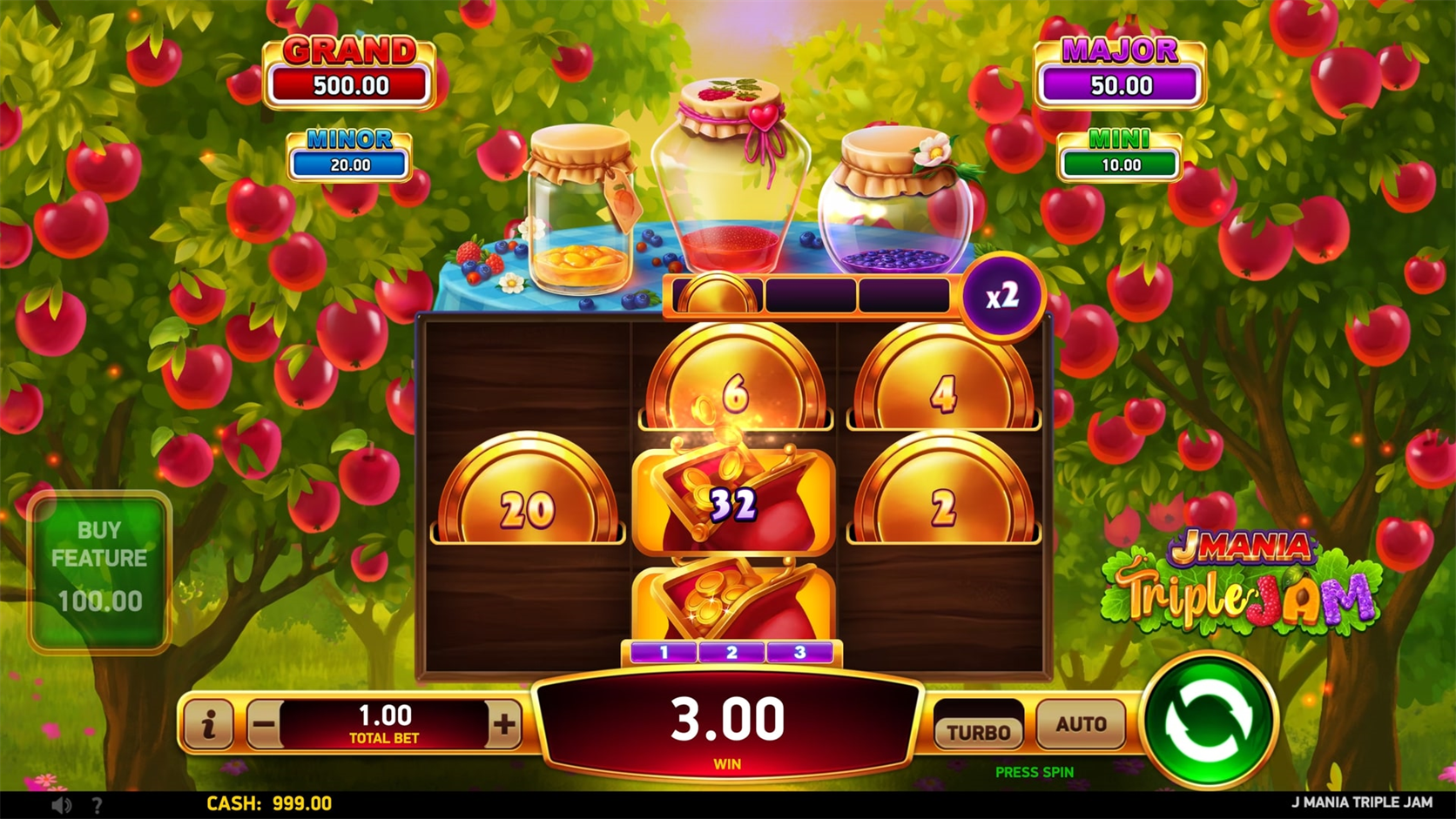
The named J Mania round moves the action into an apple orchard and changes the central square into a sticky Collector. Three respins begin the sequence. Gold Prize symbols may land around the Collector, and each collected value is added to its running total.
A new Prize or Collector restores the counter to three, following the familiar hold-and-respin tension without expanding beyond the nine-cell board.
The official screenshot above shows why the layout works. Prize discs carrying 20, 6, 4, and 2 surround a central Collector displaying 32. A second Collector sits below it, while the multiplier has already reached x2. Nothing important is hidden in a side panel; the state of the round can be read directly from the grid.
Every three Prize symbols collected increases the multiplier by two, again moving toward a maximum of x128. The round therefore counts more than the printed coin values. A modest Prize can complete a group of three, raise the multiplier, and affect the final collected amount. Symbol timing becomes almost as important as symbol size.
Additional Collectors can appear. This is where a tiny grid produces its most complicated decisions for the math engine. A single central jar gathers nearby Prize value into one total. Multiple Collectors create more collection events and can change the value of every new gold disc. The visible numbers may remain small, but duplication and multiplication can reshape the final sum quickly.
The best sequences tend to combine four conditions: an early stream of Prize symbols, enough new landings to keep resetting the respins, extra Collectors, and multiplier growth before the board runs out of time.
Missing any one of those conditions can flatten the result. Large printed values with no reset end the round too soon. Many resets with weak values create duration without much money. A rising multiplier reached on the final landing has little room to influence later collection.
This mode also explains the high-volatility classification more convincingly than the base reels do. The collector can end after a short, thin sequence, or it can keep reviving while totals and multipliers stack. Both outcomes start from the same three-spin counter. The gap between them is wide, and the player cannot steer which branch appears.
J Mania is the most coherent part of the slot because its theme and arithmetic point in the same direction. Fruit becomes jam, Prize values pour into the central jar, and the jar becomes more valuable as collection groups accumulate. The mechanism is easy to read without feeling mechanically empty.
Jackpot Pick changes the tempo completely
Jackpot Pick removes the reels and presents twelve covered tiles. The task is to reveal three matching jackpot symbols. Four tiers are available: Mini, Minor, Major, and Grand. The first set of three matching symbols determines the award.
Random multipliers may attach to jackpot symbols, so matching a tier does not always settle at the plain displayed level. An official screenshot shows a Grand tile carrying x2, illustrating how the board can modify the jackpot result after the tier has appeared.
The jackpot meters shown above the base game move with the selected stake. In official media using a total bet of 1.00, the display reads Mini 10.00, Minor 20.00, Major 50.00, and Grand 500.00. Those screen values should be read in relation to that wager, not copied as universal cash prizes across every currency and bet size.
This round is far shorter than the two collection systems. It has no multiplier ladder to build over several spins and no respin counter to rescue. Its drama comes from the sequence of revealed icons. Two Grand symbols create a strong possibility, but the third match may still complete a lower tier first.
The selection itself does not create a repeatable skill edge. Once the tiles are presented, tapping a different position changes the reveal order, not the underlying expected return. The value of the round lies in suspense and tier variance rather than decision-making.
Placing Jackpot Pick beside Free Games and J Mania is a smart pacing choice. The first bonus is a persistent-Wild sequence, the second is a collector respin, and the third is a compact match-three reveal. Repeated triggers do not merely reskin the same calculation.
The 100x button buys access, not control
Where local regulations permit it, the Buy Feature button costs 100 times the current total bet. A 1.00 stake therefore displays a 100.00 purchase price. The purchase immediately starts either J Mania or Free Games.
It does not let the buyer choose between those modes, and the official description does not list Jackpot Pick as a direct purchase outcome. That distinction should be stated plainly because the button can otherwise look like a menu for all three bonuses. It is a random ticket to one of two longer modes.
The lack of selection changes how the price should be interpreted. Someone paying specifically to see J Mania may instead receive Free Games. The purchase removes the wait for a natural trigger, but it does not remove bonus identity variance or result variance inside the selected round.
The 100x cost also magnifies the contrast between the modest base grid and the bonus economy. One press represents the price of one hundred standard spins at the same stake. A weak collector or quiet Free Games round can therefore feel severe even if its result would have looked acceptable after a natural trigger.
Availability and mathematical settings can vary by market. Some casinos remove bonus purchases entirely. When the button is absent, that is normally a jurisdiction or operator configuration rather than a broken interface.
Reading the 96.36% RTP and 37% hit rate together
RTP, hit frequency, volatility, and maximum win answer different questions. Combining them gives a more accurate picture than treating any one figure as a quality score.
The 96.36% RTP concerns a very large theoretical sample. The 37% hit frequency concerns how often some paying result occurs under the published model. High volatility describes the uneven distribution of value. The 5,000x maximum sets the upper boundary for a single result.
Taken together, these figures suggest regular small contact with the pay system alongside concentrated bonus value and rare top-end outcomes. The 3x3 board may register plenty of minor combinations, but those hits do not force the balance upward. Much of the serious potential sits behind collectors, persistent multipliers, jackpot matching, and unusually strong symbol timing.
The maximum win is substantial for such a small slot, though it is lower than the 10,000x or 50,000x headlines attached to some modern releases. That restraint fits the compact model. The game aims for sharp bonus swings without pretending that every ladder ends in an astronomical ceiling.
A visible 37% hit rate may tempt readers to describe the slot as forgiving. That would be misleading. Hit frequency does not measure average hit size, the length of losing runs, or the chance of entering a particular bonus. A sequence of low returns can satisfy the statistic while still producing a steep net loss.
The art is doing practical work
The kitchen is more than decoration. Its shelves, window, jars, and bowls create a fixed frame around the small reel set. Jackpot meters occupy the upper corners, the feature purchase sits on the left, and the spin control remains isolated on the lower right. Even before reading the help screen, the hierarchy is clear.
Bonus backgrounds act as state markers. The warm kitchen belongs to standard play. The apple orchard belongs to J Mania. Other fruit-garden scenes support Free Games and Jackpot Pick. A background change tells the player that the rules have shifted before any instruction panel is read.
Sound follows the same compact approach. Base spins use short kitchen-friendly cues, while collection and jackpot events receive heavier accents. The audio does not need to simulate an epic adventure; it needs to mark a Prize landing, a counter reset, a multiplier step, or a jackpot reveal. That narrower job suits the game.
On a phone held sideways, the layout remains legible because there are only nine symbol cells. The numbers printed on Prize discs are large, the Collector total sits in the center, and the multiplier occupies a separate badge. The wide landscape screenshots also show adequate spacing around the controls, reducing the chance that the feature button and normal spin button are confused.
The largest presentation weakness is thematic familiarity. Fruit, jam, hearts, and rural kitchens are safe choices. There is no character arc or narrative surprise. The visual identity depends on polish and mechanical clarity rather than an unusual setting. That is enough for a short-session slot, but players seeking a darker or more cinematic theme will find little to hold onto outside the bonus rules.
Where the design succeeds and where it pinches
The strongest decision is giving the middle position a different role in different modes. In Free Games it is a sticky substitute. In J Mania it is a sticky accumulator. That reuse makes the rules easy to remember and gives the 3x3 geometry a real identity.
The three bonuses also differ meaningfully. Many small slots repeat one hold-and-respin pattern under several names. Triple Jam separates persistent Wild collection, Prize accumulation, and jackpot matching. A bonus trigger changes the way the screen is read, not merely the background art.
The main pressure point is random feature assignment. Natural triggers do not grant a choice, and the 100x purchase still selects between J Mania and Free Games. Someone who strongly favors one mechanism may spend much of a session entering the other.
Base play can feel thin during a cold stretch. There are only 27 routes and little secondary action when no trigger appears. The Trigger Chance symbol helps break that monotony, but it does not guarantee that every session develops a satisfying rhythm.
The multiplier caps are attention-grabbing, yet their upper levels require a very specific chain of collection. The game is at its best when the tracker rises early and the remaining spins or respins stay alive. When progress comes late, the same mechanism can feel like a glimpse of value arriving just after it can matter.
Final read
J Mania Triple Jam earns its identity through structure rather than scale. Nine reel positions are enough because the center square keeps changing jobs, and the three bonus modes ask the player to watch three different kinds of progress. Free Games builds a persistent Wild multiplier, J Mania turns Prize symbols into a growing collected total, and Jackpot Pick compresses the result into a four-tier match race.
The published 96.36% RTP is competitive, but the high-volatility model should carry more weight when judging the likely session feel. A 37% hit frequency can produce plenty of small reel contact while meaningful value remains concentrated in bonus chains. The 5,000x cap gives the math room for a major result without turning the entire identity into a maximum-win advertisement.
Its weakest moments occur between meaningful symbols. The base grid is clean but spare, and random bonus assignment can send a trigger toward a mode the player did not want. The 100x purchase retains that uncertainty instead of selling direct access to a chosen round.
Still, the game understands the advantage of a small board: every important landing is visible. A gold Prize appears, the center jar collects it, the counter resets, and the multiplier reacts. There is no clutter to hide the cause and effect.
J Mania Triple Jam is a tightly built high-variance slot for readers who prefer clear mechanics, short base spins, and bonus rounds whose state can be understood from a single glance.
By Fairy Editorial - 27 Jul 2026

Lucky Penny
Lucky Penny Review: Why One Small Coin Can Rewrite an Entire Cascade
Lucky Penny places its most dangerous symbol inside a coin no larger than the gems surrounding it. That coin may carry x2, x20 or something as extreme as x1,000. It does not immediately multiply a single matching group. The game waits for the entire cascade sequence to finish, adds the visible Penny values together and applies the combined figure to the accumulated win.
This timing changes how the board is read. A small cluster at the start of a spin may look unimportant, yet several removals can build a larger running total before the multiplier calculation arrives. A high-value Penny without a paying cluster is far less useful. Lucky Penny needs both sides of the equation: enough matching symbols to create money and enough Penny power to change its scale.
First, Identify the Correct Lucky Penny
Lucky Penny is a 2024 BNG release, developed under the studio previously known as Booongo. The name also appears on unrelated casino products, so the provider and visual identity matter. This version uses a red-bearded leprechaun, a 6x5 blue grid, scatter-style count payouts, cascading symbols and clover Penny multipliers.
BNG gives July 18, 2024 as the official release date. The provider page confirms the following core rules:
Six reels and five rows
Wins begin with at least eight identical symbols anywhere on the board
Winning symbols disappear and new symbols fall into the empty positions
Wild symbols assist regular combinations
Penny multipliers range between x2 and x1,000
Multiple Penny values are added together
Free Spins use a cumulative Total Multiplier
Free Spins and Super Free Spins may be purchased in supported markets
Those mechanics are stated on the official BNG Lucky Penny page. The game splash screen advertises a maximum result of 20,000x the wager, though RTP and volatility are not published on BNG’s public listing.
Thirty Positions, No Payline Map
The 6x5 board contains thirty symbol positions. There are no fixed horizontal lines and no requirement for matches to touch one another. Eight matching symbols anywhere on the board are enough to create the lowest count payout.
Increasing the count raises the symbol value. Common thresholds are eight, ten and twelve or more matching symbols, with the exact payout determined by the paytable. The top regular symbol is the golden horseshoe, followed by the beer mug, smoking pipe and money bag. Coloured gems form the lower-value half of the set.
This payment model makes distribution more important than alignment. A horseshoe in the upper-left corner can belong to the same result as another in the lower-right. What matters is the total number present when the grid is checked.
The wide board also creates deceptive near-results. Seven matching gems may be spread across six reels and still pay nothing. Eight may activate a removal even though none of them form a conventional line. Anyone approaching the game with payline habits needs a few rounds to stop looking for left-to-right patterns.
Cascades Turn One Stake Into Several Board Checks
After a paying group is identified, its symbols disappear. Remaining symbols fall downward and new ones enter from above. The refreshed board is evaluated again without charging another stake.
The process repeats until no group reaches the required count. A spin may therefore contain one quick win or a longer chain of removals. Lucky Penny records the money generated across the whole sequence before handling the Penny multipliers at the end.
The opening board still matters because it decides how much space the first removal creates. Eliminating eight symbols clears more than a quarter of the grid. Removing twelve or more creates enough empty positions for the replacement drop to substantially change the symbol balance.
Long chains are not guaranteed to be large chains. Several low-value gem groups may disappear in succession while the accumulated amount remains modest. Conversely, a single large horseshoe group may produce more money than a visually busy sequence of low symbols.
The cascade mechanic creates movement, but the final total remains tied to symbol value, matching count and the presence of Penny multipliers.
Penny Coins Wait Until the Sequence Is Over
The clover Penny is the defining symbol. Each coin displays a multiplier between x2 and x1,000. It may enter naturally with a symbol drop or appear through an intervention from the leprechaun beside the grid.
Penny values do not need to match. If x3, x20 and x50 coins take part in the same completed sequence, their values combine to x73 rather than multiplying one another. The sum is then applied after the last cascade has settled.
That distinction prevents a common misreading. Three coins marked x3, x20 and x50 do not create x3,000. They create x73. The difference is enormous, especially when promotional screenshots place several brightly lit coins on screen at once.
The multiplier also needs something to multiply. A spin showing a large Penny but no valid eight-symbol result cannot create a payout merely because the coin is present. Penny value and cascade value must meet in the same resolved sequence.
The strongest base-game pattern is therefore not simply the largest coin. It is a useful multiplier attached to a sequence that has already accumulated several wins. An x20 applied to a healthy cascade may matter more than an x100 attached to a tiny symbol total.
The Leprechaun Is a Mechanical Character
The character standing beside the board is not restricted to celebration animations. BNG states that Penny symbols may arrive with his help, giving him a direct role in the multiplier system.
His intervention can place additional Penny coins onto the grid before the sequence is evaluated. This creates one of the game’s sharper reversals: a routine-looking board may receive a multiplier after the main symbols have already landed.
The animation is easy to overvalue. The character appearing does not guarantee a high coin, and a high coin still needs an accompanying win. His role is best understood as a random multiplier injection rather than a guaranteed reward event.
The full-body figure also acts as the Scatter symbol on the grid. Four or more Scatter portraits open the Free Spins round, while larger Scatter counts grant a longer starting allocation.
Free Spins Change the Lifespan of Every Multiplier
The base game settles Penny values at the end of one cascade sequence. Free Spins extend their importance through a persistent Total Multiplier displayed above the board.
Each Penny collected under the required bonus conditions adds its value to that Total Multiplier. The total is not discarded after one free spin. It remains in place and may rise again when later Penny symbols arrive.
This creates a different bonus curve from a round that resets every spin. Early multiplier coins have more time to affect later wins. A substantial increase on the final spin has less opportunity to influence the result, even if the number itself looks impressive.
The standard trigger schedule documented in the game rules is:
Four Scatters award 15 Free Spins
Five Scatters award 20 Free Spins
Six Scatters award 25 Free Spins
Three or more Scatters during the bonus add five spins
These trigger counts and purchase details are reproduced in a rules-based Lucky Penny breakdown. Casino implementations may disable bonus purchases or use a certified regional configuration, so the live information panel remains the final reference.
Retriggers have unusual value here. Five extra spins do more than lengthen the round. They also give the already accumulated Total Multiplier five more chances to meet a paying board, along with more time for new Penny values to be added.
Why the Free-Spin Multiplier Is More Important Than Spin Count
A 25-spin trigger appears stronger than a 15-spin trigger, but raw quantity does not describe the complete bonus. Multiplier timing can outweigh the starting count.
Consider two hypothetical rounds. The first begins with 25 spins but finds few Penny coins until the last several drops. The second begins with 15, collects meaningful multipliers early and retriggers once. The shorter starting award may finish with more spins played under a much larger Total Multiplier.
This does not create a controllable strategy. Symbol drops remain random. It does explain why two bonuses with similar numbers of regular wins may return very different totals.
The bonus screen makes this relationship readable. The Total Multiplier occupies the upper portion of the interface, separate from individual Penny coins still sitting on the grid. It is possible to see the permanent bonus value and the new contributions waiting inside the current cascade.
Free Spins and Super Free Spins Are Not the Same Purchase
Supported versions display two purchase choices:
Free Spins at 100x the current stake
Super Free Spins at 500x the current stake
Super Free Spins begin with a minimum multiplier of x10. The higher price therefore buys a stronger initial multiplier condition, not a guaranteed profitable outcome.
The fivefold cost difference deserves more attention than the word Super. A 500x purchase compresses hundreds of ordinary stakes into one result. Even a round beginning at x10 may finish below its entry cost because the grid still needs valid symbol groups and further multiplier growth.
Bonus purchases also play at the selected stake that was active when the purchase was confirmed. Changing the displayed bet changes the cash cost even though the quoted multiplier remains 100x or 500x.
Some Philippine-facing casinos may remove one or both buttons. This can result from platform policy, local rules or the certified game package chosen by the operator. A screenshot showing both choices does not prove they will appear in every lobby.
The Public RTP Numbers Do Not Agree
BNG’s public Lucky Penny page does not list an RTP percentage or volatility rating. Independent databases display several values, including 95.64%, 96% and 96.01%.
That disagreement is too large to hide behind a rounded figure. The likely explanation is that multiple certified RTP configurations exist, or that some databases recorded different builds. It would be inaccurate to present one percentage as universal without checking the help panel loaded by the casino.
The correct number for a real session is the one shown inside that operator’s game client. A review page, old screenshot or search result cannot override the configuration actually being played.
The 20,000x maximum is more consistently reported and appears on the game’s own introduction screen. That ceiling, x1,000 Penny symbols and a cumulative bonus multiplier point toward a volatile structure, even though the provider does not publish a public volatility label.
High maximum exposure does not describe ordinary frequency. Most Penny coins will sit far below x1,000, and many spins will end before a useful cascade develops. The upper limit represents the cap on an exceptional result, not a normal target for a short visit.
Reading the Symbol Set Without Visual Noise
Lucky Penny uses strong colour separation on a deep blue grid. Horseshoes glow orange and gold. Beer mugs carry green clover marks. Pipes use blue frames, while money bags sit on purple backgrounds. The gem shapes remain distinct even when several disappear at once.
Penny multipliers use circular clover coins with large numerals. This is important because their values must be read quickly before the next cascade. The Wild is a large gold W, and the leprechaun portrait is difficult to confuse with a regular icon.
The forest behind the grid moves between warm gold during ordinary play and purple-blue lighting during Free Spins. That change gives the bonus a different visual temperature without replacing the symbol set.
The soundtrack leans on pipes, light percussion and short coin sounds. Longer cascades gradually add layers, while multiplier contributions receive a stronger metallic cue. The character’s reactions may become repetitive during extended play, though the game keeps the board legible when several animations occur together.
The Mobile Layout Is the Natural Fit
Thirty symbol positions require space, yet the interface remains readable on a horizontal phone screen. The grid occupies the centre, the leprechaun stays to the side and the spin controls run along the opposite edge.
The Total Multiplier sits above the grid during Free Spins, where it can be checked without opening a secondary window. Balance, bet and total win remain below the reels.
On a narrow portrait display, the game may scale the grid more aggressively, making small multiplier values harder to inspect. Landscape orientation is the better choice when the casino browser allows rotation.
The images in this review use a large editorial 16:9 reconstruction based on BNG’s official art and real gameplay references. They preserve the 6x5 structure and symbol relationships while making the interface readable inside a horizontal article.
The Parts That Carry the Game
The delayed multiplier calculation is the main strength. Penny values wait for the cascade chain to finish, so the player watches both the running symbol win and the multiplier sum develop together.
Free Spins build on that idea instead of replacing it. The Total Multiplier survives between spins, giving early Penny coins lasting importance. Retriggers extend the use of a multiplier that has already grown.
The eight-symbol threshold also suits the 6x5 grid. It creates frequent near-misses, but a successful removal clears enough positions to make the replacement drop visually meaningful.
Finally, the maximum Penny value of x1,000 gives any character intervention or new coin a reason to be watched, even when most outcomes land far below that figure.
Where the Penny Loses Some Shine
The Irish folklore theme is familiar territory. Leprechauns, rainbows, pots of gold and clovers appear in countless slot releases. Lucky Penny relies on its cascade mathematics to separate itself from that crowd.
The bonus purchase prices are also severe. A 500x Super Free Spins entry may end quickly despite its x10 minimum starting multiplier. The label changes the initial condition, not the random nature of the result.
RTP uncertainty is another weakness for review purposes. A casino should make the active percentage easy to locate, especially when public databases disagree.
The wide 6x5 board can produce many visually active drops that add little money. Repeated low-gem removals may look stronger than their paytable value, particularly before a multiplier is applied.
There is also a timing frustration built into the bonus. A large Penny arriving near the end of Free Spins has fewer remaining opportunities to affect future wins. The same coin appearing early would have been far more valuable.
Final Assessment
Lucky Penny is a cascade slot with a delayed calculation at its centre. Eight matching symbols start the process, removed icons make room for another board, and Penny coins wait until the sequence closes before applying their combined multiplier.
The base game already has enough structure to stand on its own, but Free Spins reveal the stronger version of the idea. Penny values feed a Total Multiplier that persists across the round, making the order of events almost as important as the values themselves.
The 20,000x cap and x1,000 Penny range give the game serious top-end exposure. At the same time, the missing universal RTP figure and costly 500x Super purchase deserve plain disclosure.
Lucky Penny works because the smallest object on the screen carries the largest consequence. The leprechaun, rainbow and gold are familiar decoration. The real identity lies in the pause after the last cascade, when every collected Penny is finally counted and the completed sequence learns what it is worth.
By Fairy Editorial - 27 Jul 2026

FORTUNE MONEY BOOM
Fortune Money Boom Review: Three Firecrackers Control the Whole Slot
Fortune Money Boom does not hide its operating system behind a complicated paytable. Three oversized firecrackers sit above the reels, each carrying a counter and each tied to a different reward route. Blue controls the Free Game, pink controls the Bonus Game, and green controls Fortune Boom. The reels matter, but much of the tension comes from watching those three counters and knowing that a matching Wild may move one of them closer to its guaranteed trigger.
That meter structure gives the slot a different tempo from a conventional Chinese-fortune release. Ordinary wins keep the balance moving, while the counters create unfinished business between spins. A quiet round may still leave visible progress on the screen. A matching set of Wild rockets may skip the remaining wait and start the linked mode immediately.
The Numbers Behind the Fireworks
Fa Chai lists Fortune Money Boom with the following specifications:
Provider: FC, also known as Fa Chai Gaming
Official release date: October 16, 2024
Layout: 5 reels and 3 rows
Pay system: 243 ways
Listed RTP: 96.5%
Volatility: Medium
Maximum win: 1,000x the total bet
Main modes: Fortune Boom, Free Game and Bonus Game
Additional systems: Retriggers, game jackpots and a progressive jackpot display
These figures come from the official Fa Chai product page. The 1,000x cap is lower than the ceiling attached to many recent video slots, so the appeal rests more on meter activity and repeatable side modes than on a remote five-digit multiplier.
A Base Screen Built Around Three Counters
The reel window uses a straightforward 5x3 arrangement. Matching symbols pay on adjacent reels from the left under the 243-way system, so a winning route does not need to follow a fixed horizontal line. The symbols may occupy different rows as long as they appear on consecutive reels.
The regular set includes the smiling lucky child, a gold fish statue, a decorative knot and card ranks. Cash symbols carry printed values rather than standard paytable amounts. Their presence prepares the board for Fortune Boom, where those values become the main event.
The three rockets above the grid are more than progress bars. Each has its own colour, counter and associated Wild:
Blue Wild feeds the Free Game meter
Pink Wild feeds the Bonus Game meter
Green Wild feeds the Fortune Boom meter
Fa Chai states that a Wild may raise its linked counter or set off the associated mode before the counter reaches its guaranteed threshold. Three matching Wild symbols on the reel board trigger the linked mode automatically. That relationship is confirmed in the provider’s official launch explanation.
This arrangement makes mixed-colour Wild screens slightly frustrating by design. A blue, pink and green Wild may all help regular ways wins, yet they do not form the matching trio needed for an immediate side-mode trigger. Three of the same colour carry far more mechanical weight.
Fortune Boom Turns the Grid Into a Cash Board
Green Wilds belong to Fortune Boom. When this mode starts, cash symbols are placed across the reel area. The number introduced is tied to the amount accumulated on the green meter. If a new cash symbol lands on a position that already holds a value, the amounts are added together rather than discarding the earlier prize.
This is the clearest payoff for meter progress. A low counter may produce a thinner board, while a fuller meter gives the cash round more material to work with. The 5x3 grid only has fifteen spaces, so overlapping additions become relevant when the count grows. Repeated placement on the same position can build a value without requiring every cell to be filled.
The green counter normally returns to its starting state after Fortune Boom resolves. That reset prevents the base game from repeatedly firing the same accumulated amount. It also explains why a trigger just below the guaranteed threshold can feel mixed: the mode has arrived early, but the stored count has not reached its highest possible level. The placement and reset sequence is documented in an independent demo breakdown.
The four jackpot panels remain visible during the game:
Grand
Major
Minor
Mini
The amounts shown in promotional screens should not be treated as universal cash values. Currency, stake level, casino configuration and jackpot pool rules may change what appears in a live lobby. Fa Chai classifies the title under both game jackpot and progressive jackpot mechanics, so the active help screen is the proper place to confirm how a particular operator calculates each tier.
Free Game Alters the Green-Wild Relationship
The blue Wild controls the Free Game route. The stored blue value influences the number of awarded spins, giving meter progress a direct connection to bonus length rather than merely deciding when the round begins.
Inside the Free Game, the green Wild becomes gold. This change matters because the gold version adds to the Fortune Boom counter when it appears. The counter is not cleared after a Fortune Boom activation during the free round, leaving room for the cash mode to fire more than once before the remaining spins reach zero.
That non-resetting green counter is the strongest link in the design. Free spins are not isolated from the base-game firecracker system. They reuse it under more favourable rules and turn every gold Wild into progress toward another cash-board event.
Some reviewed builds also display a possible x2 state for cash values during this section. As game configurations may differ between operators, the exact multiplier condition should be checked in the information menu of the active version rather than assumed from promotional footage.
The free round can therefore vary sharply without needing a huge reel win. One run may contain ordinary 243-way results and little green activity. Another may collect several gold Wilds, set off Fortune Boom repeatedly and double selected cash values. The spin count alone does not explain the final total; the behaviour of the green meter matters just as much.
The Pink Route Is a Separate Bonus Game
Pink Wilds build toward the Bonus Game. This route leaves the normal reel structure and moves into a prize-selection sequence containing coins or covered rewards.
The stored pink value governs how much access the round grants. Revealed positions may contain cash amounts, jackpot results or Money symbols. The One More Time mechanic keeps the sequence alive after certain reveals, so collecting one prize does not always close the round.
Fa Chai specifically describes this mode as capable of awarding several jackpots within one bonus sequence. That separates it from pick rounds that stop immediately after a single jackpot symbol appears. A Money result may also add to the accumulated bounty before the sequence ends.
The Bonus Game is less transparent than Fortune Boom because its possibilities remain hidden until selections are made. Fortune Boom shows cash values directly on the grid; the pink route asks the player to uncover them. The underlying outcome remains random in both cases, but the presentation creates two distinct forms of suspense.
Meter Progress and Stake Changes
The counters make the base game look persistent, but their behaviour deserves attention before changing the wager. The same demo breakdown reports that meter progress is tracked separately for each bet level. Moving to a different stake may therefore reveal a different set of stored values rather than carrying the visible counters across unchanged.
That rule prevents a counter from being filled cheaply and triggered at a much larger wager. It also means that repeatedly switching stake sizes may fragment visible progress across several bet levels.
The practical lesson is not a betting system. Meter position does not predict when a random early trigger will occur, and a nearly full counter does not make the underlying spin profitable. It only shows progress toward the guaranteed activation rule specified by the game.
How Strong Is the 96.5 Percent RTP
The listed RTP of 96.5% is competitive for a modern online slot. It is a long-run mathematical figure measured across a very large number of wagers, not an estimate of what one short visit will return.
Medium volatility also needs context. Fortune Money Boom may record ordinary ways wins while the three counters build, but much of its larger payout potential is concentrated inside side modes. A session that reaches several meter activations can look entirely different from one that ends before any of them fires.
The 1,000x maximum is the bigger limitation. A cash board, repeat Fortune Boom event or strong Bonus Game still cannot push beyond the published cap. Someone comparing titles solely by maximum multiplier will find much larger numbers elsewhere.
That lower ceiling is not automatically a flaw. It tells the reader what kind of slot this is. Fortune Money Boom concentrates its identity into frequent visual progress, three linked Wild colours and multiple chances to enter a side round. It does not rely on a giant maximum-win figure to carry the entire sales pitch.
Familiar Festival Art, More Technical Reel Logic
The lucky child, lanterns, temple roofs, coins, fish and fireworks place the game firmly inside Fa Chai’s established prosperity theme. None of those symbols will surprise anyone who has played Asian-market slots.
The stronger visual decision is the colour coding. Blue, pink and green remain consistent across the Wilds, rockets and associated modes. That lets a player understand the state of the screen without opening the rules after every spin.
Cash values use large numerals and strong gold frames. Jackpot tiers sit apart from the main grid. The three rocket meters occupy the top of the display, so progress remains visible without covering the reels.
The original interface is portrait-first and fits a mobile screen naturally. On desktop, a casino may place unused space around the vertical client. The three images in this review were reconstructed as large 16:9 editorial layouts from Fa Chai’s official artwork and screenshots so the mechanics remain readable in a horizontal article format.
Audio follows the firecracker concept closely. Meter movement uses short ignition cues, while a trigger produces a louder launch and explosion sequence. The presentation can become busy when several rockets, cash values and jackpot panels appear together, though the colour system prevents the screen from becoming incomprehensible.
Where the Design Works
Fortune Money Boom gives every Wild colour a clear purpose. A rocket symbol may complete a regular combination, add meter progress or start a linked mode. That makes Wild landings meaningful even when the immediate line result is small.
The connection between Free Game and Fortune Boom is particularly well judged. Gold Wilds keep feeding the green counter, and the lack of a reset allows repeated cash-board activations during the same bonus run.
The three meters also create visible memory between spins. Many slots return to an empty state as soon as the reels stop. Here, progress remains on screen and gives the next spin context, even though it does not remove randomness.
The three reward routes do not feel interchangeable. Fortune Boom fills the grid with visible cash amounts, Free Game extends reel play under altered green-Wild rules, and Bonus Game shifts to concealed selections with a One More Time possibility.
Where It Loses Ground
The 1,000x cap is restrained, especially beside newer titles using five-digit limits. A strong chain of side modes may look spectacular while still meeting a relatively low mathematical ceiling.
The base symbols also follow a very familiar template. The child, fish, knot and card ranks do their job, but the firecracker counters carry far more personality than the paytable icons.
Three simultaneous meters can create false confidence. A nearly full rocket looks like stored value, yet it does not guarantee that the cost of reaching the trigger will be recovered. The counter records progress toward a mode, not profit.
The jackpot presentation needs operator-specific checking. Promotional amounts, currency units and bet-linked values should never be copied directly into a prediction for another casino account.
Final Assessment
Fortune Money Boom earns its place through structure rather than theme. The festival setting is familiar, but the three-colour Wild system gives the reels a firm identity. Blue seeks more spins, pink opens a concealed-prize sequence, and green converts accumulated progress into a cash-filled board.
The best rounds occur when those systems overlap. A Free Game may turn green Wilds gold, preserve the Fortune Boom meter after activation and set off another cash-board event before the bonus ends. The pink route may then produce several prize reveals through One More Time rather than stopping after a single result.
The 96.5% RTP is respectable, while the 1,000x ceiling keeps expectations grounded. This is not the right title for someone chasing a vast headline multiplier. It is better understood as a meter-driven slot where three Wild colours constantly compete for attention and each one changes what the next trigger will look like.
Fortune Money Boom is strongest when read as a machine with three connected fuses. Every Wild lights one of them. The screen tells you how far each fuse has burned, but only the next reel stop decides which firecracker goes first.
By Fairy Editorial - 24 Jul 2026

Lucky Ace
Lucky Ace Review: A Card Cascade That Climbs From x1 to x10
Lucky Ace turns a familiar deck of cards into a cascading slot built around momentum. A single paid spin may end immediately, or it may remove a winning group, drop another set of cards into the empty spaces and raise the multiplier for the next result.
That distinction matters. The game is less concerned with rare symbol combinations and more interested in what happens after the first connection. Each successful cascade moves the round further along a short multiplier ladder. Reaching the final step is where an ordinary card win may become something much more useful.
This review covers the OmniPlay release officially listed as Cascading Lucky Ace. It should not be confused with other casino games carrying the same Lucky Ace name.
Lucky Ace Game Details
OmniPlay lists the following specifications:
Provider: OP, also known as OmniPlay
Release date: October 15, 2025
Reel layout: 5 reels and 4 rows
Winning routes: 1,024
Listed RTP: 94.5%
Volatility: Medium
Maximum multiplier: 2,000x
Main mechanics: Cascading card wins, rising combo multipliers, golden cards, Wild Diamonds, free games and the OP Jackpot
Purchase options: Buy Feature and Super Feature
Supported systems: Windows, macOS, Android and iOS
The 2,000x ceiling is modest beside slots advertising five-digit or six-digit maximum wins. Lucky Ace takes a narrower route. Its math appears built around consecutive card removals, medium-length bonus sequences and an attached jackpot system rather than a single extremely rare screen-filling hit.
A 5x4 Card Grid With 1,024 Routes
The main grid contains twenty positions arranged across five reels. Card ranks take the place of conventional fruit, animals or character symbols, making the board unusually easy to read.
Wins form through matching cards across adjacent reels, beginning from the left. Once a valid result appears, the winning cards disappear. New cards fall into the empty positions and the grid is checked again.
This process repeats until the replacement symbols fail to form another result.
The removal system changes the value of every initial win. A small connection is not important only because of its immediate payout. It also clears several positions and creates a new arrangement without charging for another spin. That second arrangement may start a larger chain.
The 1,024-route structure also helps prevent the grid from feeling too rigid. Four positions on each of the five reels create many possible paths, so symbols do not need to sit on a fixed horizontal payline. A card appearing at the top of one reel may connect with cards located lower down on the next reels.
The Base-Game Multiplier Ladder
The base-game ladder displays four values:
x1
x2
x3
x5
A new paid spin begins at the first level. Each consecutive cascade moves the active multiplier upward, with x5 serving as the final base-game step.
This short ladder gives Lucky Ace a clear rhythm. The first removal opens the board, the second starts to build value, and later reactions carry noticeably more weight. A payout recorded at x5 does not need to be enormous before it overtakes several ordinary spins.
The difficult part is maintaining the chain. New cards enter at random, and many promising rounds stop after the first or second removal. The multiplier cannot rescue a grid that fails to make another connection.
That creates a useful tension between visible progress and uncertain follow-through. A round may reach x3 with large card clusters still on screen, yet nothing guarantees that the next drop will reach x5.
Golden Cards Change the Shape of a Cascade
Certain cards may appear with a gold treatment. OmniPlay describes these as random golden cards that transform wins, though the public product page does not publish the complete conversion rules or activation probabilities.
Their role is best understood through board position rather than decoration. A transformed card may bridge a gap between matching ranks, extend a current cascade or leave a stronger arrangement for the following drop.
Golden cards become more valuable late in a chain because the active multiplier has already climbed. A conversion during the x1 stage may simply keep the round alive. The same intervention near x5 may attach a larger multiplier to the resulting payout.
This is also where Lucky Ace becomes less predictable than its plain card symbols initially suggest. The grid is easy to understand, but a golden-card change may alter a board that appeared ready to stop.
Exact conversion behavior should be checked in the live game information panel. Operators sometimes run different certified configurations, and promotional screenshots are not enough to establish every probability or rule.
Free Games Raise the Multiplier Ceiling
The free-game screen replaces the base ladder with stronger values:
x2
x4
x6
x10
That is a meaningful change rather than a cosmetic bonus reskin. A free round starts with a higher multiplier, and a sustained cascade may finish at twice the base game’s maximum combo level.
The official gameplay material shows a bonus round with nine spins remaining, but OmniPlay’s public description does not state the exact number of triggering symbols, the initial free-spin award or every retrigger condition. Those details should be confirmed through the rules screen inside the version hosted by the casino.
What can be judged from the visible structure is the importance of chain length. A single connection at x2 helps, but the largest difference appears when repeated removals carry the same free spin toward x6 or x10.
The bonus therefore has two layers of variance. First, the player needs productive free spins. Second, each productive spin still needs enough consecutive reactions to reach the upper multiplier levels.
A bonus containing many one-step wins may produce frequent movement without reaching a large total. Fewer but longer chains can be more valuable because the multiplier has time to climb.
Wild Diamonds and the OP Jackpot
Red Diamond Wild cards appear in the official free-game material. These symbols help complete card connections while also linking the grid to OmniPlay’s OP Jackpot system.
The jackpot display contains four prize levels:
Grand
Major
Minor
Mini
OmniPlay states that connecting with the Wild Diamond card may lead to the OP Jackpot. Promotional material also shows a selection screen in which a token is chosen to reveal a jackpot result.
The provider does not publish the required Wild count or full jackpot probability on the public listing. It would therefore be misleading to claim that a particular number of diamonds always opens the selection round.
Grand and Major values appear above the reels, but the displayed amounts should be treated as session information rather than fixed game specifications. Jackpot totals may depend on the casino, currency, wager and network configuration.
This jackpot connection gives the diamonds two jobs. They may improve the immediate cascade as substitutes, and they may lead into a separate prize route. That dual purpose makes them more important than an ordinary wild symbol.
Buy Feature and Super Feature
The main interface presents two purchase buttons: Buy Feature and Super Feature. OmniPlay groups the system under the label Buy Super Feature on its product page.
Keeping the two purchases separate suggests different entry conditions or bonus setups. The Super Feature would normally carry a higher price in exchange for a stronger starting state, better symbol arrangement or altered bonus parameters, but the exact cost and advantage must be read from the active game client.
This is especially important because buy prices may vary by market. A demo build, Philippine-peso casino and cryptocurrency casino may not display identical stake steps or purchase multiples.
Buying entry into a bonus also does not improve the published RTP automatically. Some slots assign separate theoretical returns to normal play and purchased rounds. Lucky Ace’s public page lists 94.5%, but it does not break down the return for each purchase button.
The purchase panel should show the cost before confirmation. The in-game help section should also state whether the Super Feature changes the free-game multiplier, Wild Diamond frequency or another bonus condition.
The 94.5 Percent RTP Needs Attention
Lucky Ace carries a listed RTP of 94.5%. That figure is lower than the roughly 96% level commonly seen in many modern online slots.
The difference may appear small on paper, but it becomes relevant across a large volume of wagers. RTP is a long-run mathematical estimate, not a promise for one session. A short visit may finish far above or far below the published percentage.
Medium volatility should not be read as stable returns. Cascading games often create stretches of small card wins interrupted by rounds where several removals occur together. The jackpot layer and bonus purchases may add another source of uneven results.
The 2,000x maximum also places a limit on the standard game’s top-end potential. This may appeal to someone who prefers a more contained ceiling, but it gives high-risk jackpot hunters less reason to tolerate the lower RTP.
For this reason, Lucky Ace makes more sense as a cascade-and-jackpot game than as a maximum-win chase. Its identity comes from climbing the combo ladder and finding diamonds, not from advertising an enormous theoretical payout that almost never appears.
How the Game Feels on Mobile
Lucky Ace was designed around a portrait-oriented interface. The reels occupy the middle of the screen, the multiplier ladder stays visible and the jackpot values sit above the grid. The main controls remain near the bottom, within thumb reach.
Card ranks are practical on a small display. They require less visual decoding than detailed character symbols, and winning groups remain readable after several cards disappear at once.
The dealer character and casino background frame the grid without taking over the playable area. Gold cards and red diamond wilds have enough contrast to remain identifiable during a rapid cascade.
The sound design follows the same escalation as the multiplier. Early card removals use shorter effects, while longer chains receive stronger audio cues. The result is functional rather than cinematic, which suits a game built around repeated drops.
On a larger desktop screen, the board gains more breathing room, but the underlying presentation still feels mobile-first. That is not a weakness for Philippine users who mainly access casino games through Android devices.
What Lucky Ace Gets Right
The multiplier ladder communicates progress immediately. There is no need to search through several counters to understand the current stage of a cascade.
The card-based symbols also keep the 1,024-route board readable. Even when several replacements arrive, matching ranks are easier to track than heavily illustrated icons.
The free-game ladder makes the bonus mechanically stronger from the first successful result. Raising the sequence from x1, x2, x3 and x5 to x2, x4, x6 and x10 gives the bonus a clear mathematical reason to exist.
Wild Diamonds also connect the normal reel action with the jackpot layer. They are not placed on the board merely as substitutes; they carry a second possibility that changes how the screen is read.
Finally, the 2,000x cap gives the game a more restrained identity. It avoids pretending that every session is a route to a life-changing hit.
Where Lucky Ace Falls Short
The 94.5% RTP is the most serious drawback. A lower theoretical return is difficult to ignore when many competing cascade slots sit closer to 96%.
The public rules are also too thin. OmniPlay’s promotional page mentions golden transformations, Wild Diamonds and the OP Jackpot without publishing enough detail to calculate how each system behaves.
The two purchase buttons may create another concern. Fast access to the bonus is convenient, but repeated purchases can raise total wagering far more quickly than ordinary spins. The Super Feature label may also tempt users to assume a guaranteed strong result when it only changes the entry conditions.
Some sessions may feel repetitive before a long cascade appears. Card symbols keep the board clean, but they also give the base game less visual variety than a character-heavy slot.
The restrained 2,000x ceiling will divide opinion. It suits the game’s compact mathematics, though anyone seeking a very high maximum multiplier may dismiss Lucky Ace before the cascade system has a chance to make its case.
Final Verdict
Lucky Ace works best when several modest systems meet in the same round. A card connection begins the cascade, removed symbols make room for another match, the multiplier climbs, golden cards interfere with the board and Wild Diamonds introduce the possibility of an OP Jackpot result.
Its strongest section is the free game. Moving through x2, x4, x6 and x10 gives every additional cascade a visible purpose, while the Diamond Wilds add another reason to watch each replacement card.
The lower 94.5% RTP prevents an unqualified recommendation. The missing public detail around bonus triggers, jackpot activation and Super Feature conditions also means the in-game rules deserve careful reading before any real-money session.
For players drawn to card symbols, drop mechanics and compact multiplier ladders, Lucky Ace has a clear identity. It is not a giant-max-win slot disguised as a casual card game. It is a controlled 2,000x cascade with a stronger free-game ladder and a jackpot system waiting behind its red diamonds.
By Fairy Editorial - 24 Jul 2026

FORTUNE GODDESS
Fortune Goddess Review: The Palace Vortex That Changes Every Gem on the Board
Fortune Goddess places its most important symbol on reel five. Until the golden Palace lands there, the jewels scattered across the other reels are mostly unrealised values. When the Palace appears, a vortex sweeps across the grid, gathers those jewels and converts the entire screen into a collection event.
That relationship between the Palace and the gemstones separates Fortune Goddess from a routine 243-ways slot. The normal symbols pay through left-to-right combinations, but the larger mechanical story is happening somewhere else: gems must spread across the reels, the collector must arrive at the right time, and the bonus board must climb through increasingly valuable stages before its three-spin counter runs out.
Fa Chai’s official page lists a 96.5% RTP, medium volatility, 243 winning ways and a maximum result of 1,000x the stake. The studio also identifies Free Game, Hold & Spin, Buy Feature, game jackpots and a progressive jackpot among the included systems. Its official release date is December 25, 2024, despite several independent catalogues displaying earlier December dates.
The Base Reels Hide the More Important Game
The standard screen uses five reels and three rows. A winning way begins on reel one and travels through adjacent reels with matching symbols. Exact horizontal alignment is unnecessary, giving the grid 243 possible symbol routes.
Card ranks sit near the bottom of the paytable. The character and cultural symbols include an oil lamp, ornamental jewellery, a lion, an elephant and the goddess herself. A lotus acts as the Wild, replacing regular paying icons while excluding gemstone jackpot symbols and the Palace.
These combinations form the conventional side of Fortune Goddess. They keep the balance moving while the grid waits for gemstones and the reel-five collector.
The slot does not use cascading wins as its main structure. A completed normal spin is evaluated, paid and replaced by the next independent round. Gemstones therefore carry more visual importance than ordinary reel symbols because they are tied to direct values, jackpot labels and bonus activation.
Every Gem Is Waiting for Reel Five
Gemstone symbols may contain cash values or named jackpot awards such as Mini, Minor, Major and Grand. Their displayed amounts scale from the active wager or jackpot configuration, so screenshots from different operators may show different numbers.
A gem does not need to form an ordinary 243-ways combination. Its value belongs to the collection system. The Palace symbol, restricted to the fifth reel, is responsible for pulling those values from the grid.
When the Palace arrives during the base game, the screen turns into a vortex. Visible gemstones are drawn toward the collector and their values are counted. This can create a prize without a conventional left-to-right match.
The timing is entirely random. A grid may contain several valuable gems but no Palace, leaving those amounts uncollected. Another spin may land the Palace beside only one or two modest values. The screen shows what might have been, which gives the base game a noticeably sharper sense of near-miss pressure than the standard animal and card symbols.
Gemstones appearing across all five reels activate the Free Game. If the Palace is part of that triggering layout, the visible gem values are gathered before the bonus sequence starts.
The Three Green Counters Explain the Bonus Better Than Its Name
Fa Chai calls the round a Free Game and separately lists Hold & Spin in the product details. On screen, these ideas are closely connected. The bonus uses a three-position counter below the reels, resembling the familiar three-respin structure used by collection slots.
Three rounds are placed on the counter. Valuable gemstone symbols remain central to the process, and landing another eligible gem restores the counter to three. A dry result removes one remaining round. The sequence ends after three consecutive rounds fail to place another qualifying symbol.
This reset rule matters more than the initial allocation. A bonus can finish quickly after three empty drops, or survive much longer if new gemstones keep arriving before the counter reaches zero.
The grid is not merely collecting a fixed set of coins until time expires. Fortune Goddess adds a progression layer that can clear the current board, bank its value and raise the minimum quality of the next group of gems.
Clear and Rise Turns Collection Into a Staircase
The Palace retains its reel-five restriction during the Free Game. When it appears, it activates Clear & Rise.
The current gemstone values are gathered first. The board then advances to a higher prize stage, where the minimum gem value increases. The collected layout is cleared, making room for a new set of symbols at the stronger level.
This produces a staircase rather than one uninterrupted hold-and-spin board:
- Gemstones accumulate at the current prize level
- The reel-five Palace activates the vortex
- Existing values are collected
- The board moves to the next stage
- The minimum value attached to later gems rises
- The three-round collection cycle resumes
Independent rule summaries state that Clear & Rise may occur as many as four times in one Free Game. Reaching the later stages requires the Palace to return before the bonus counter expires, so the full climb should be treated as a rare sequence rather than a normal expectation.
A rise does not multiply every future reward by one universal figure. It changes the floor from which later gemstone values are selected. That is an important distinction. The screen becomes more valuable because weaker possible gems are removed from the next stage, not because every result receives a fixed multiplier.
The mechanic also prevents the bonus from becoming visually stagnant. Many hold-and-spin rounds fill the board slowly until no empty positions remain. Fortune Goddess can empty a developed grid, bank it and begin a second collection phase at a higher level.
The Palace Is Powerful but Never Under Player Control
The Palace performs three related jobs:
It gathers visible gemstones in the base game
It helps transfer a triggering layout into the Free Game
It activates Clear & Rise when it returns during the bonus
Its importance can create the impression that the player is building toward a decision point. No choice is actually involved. The Palace cannot be held manually, selected or moved between reels. Changing the wager does not make reel five more likely to produce it on the next spin.
The same limitation applies to the gems. A large amount displayed on the board is not money already won. It only becomes relevant when the collection rules recognise it. Reading the symbol as a pending possibility rather than a confirmed payment avoids one of the most common misunderstandings in this style of slot.
Filling All Fifteen Spaces Produces a Different Prize
A complete 5x3 board contains fifteen positions. Filling all fifteen with qualifying gemstone symbols activates the Full Reel Bonus.
The official game image labels this event as Full Reel Bonus 2X. The collected value of the filled grid is doubled before the round proceeds or settles according to the active stage.
This is not the same as reaching the next Clear & Rise level. The two events have separate purposes:
Clear & Rise collects the current board, raises the minimum gem value and starts another stage
Full Reel Bonus rewards a completely occupied grid with a 2x calculation
The distinction creates two competing routes inside the same bonus. An early Palace may collect a partially developed board and improve later gem quality. A delayed Palace gives the grid more time to fill, raising the chance of reaching all fifteen positions but also risking the loss of remaining rounds.
Nothing allows the player to choose between those routes. Still, understanding them explains why an apparently strong board may clear before it reaches fifteen spaces, or why a lower-stage full grid may pay differently from a sparse grid at a later stage.
Jackpot Labels Are Symbols, Not Separate Side Bets
Mini, Minor, Major and Grand gemstones appear inside the same collection structure as numbered values. Fortune Goddess also carries a progressive component, meaning the displayed jackpot figures may differ by operator, currency, stake configuration and current pool status.
A named jackpot symbol is excluded from normal Wild substitution. The lotus cannot manufacture a missing Grand or turn an ordinary ways win into a jackpot result.
The jackpot display at the top of the screen is visually prominent, but the 1,000x official maximum still defines the stated exposure for the game configuration published by Fa Chai. A large currency figure shown in a promotional screenshot should not be mistaken for a result available at every bet level or casino.
This is particularly important for Philippine-facing platforms. Some operators display credits, some convert values into pesos, and others use denomination-based totals that look much larger than the underlying stake multiple. The rules screen inside the local version is the safest place to check the active jackpot values.
The Buy Button Changes Access, Not the Mathematics of Luck
Fortune Goddess includes a Buy Feature that grants direct entry to the bonus for a displayed cost linked to the current wager. It removes the wait for a natural trigger but does not make the resulting bonus predictable.
Buying the round should not be confused with purchasing a guaranteed profit. The bonus can still end after a short collection sequence, fail to trigger Clear & Rise or stop before the Full Reel Bonus appears.
The button also increases the amount committed to a single result. A player who normally watches dozens of low-stake base rounds may spend the equivalent of many spins in one action. That change in exposure is more meaningful than the time saved.
Availability may vary by operator or region. If the button is absent, it may have been disabled in that game configuration rather than removed from Fortune Goddess globally.
Medium Volatility Does Not Mean Even Results
Fa Chai classifies the slot as medium volatility. That label describes the mathematical distribution used by the provider; it does not promise a steady pattern of wins.
Fortune Goddess can switch between two very different rhythms. Normal 243-ways payments may appear with limited ceremony, while gemstone boards create larger gaps between visible potential and collected value. The bonus also concentrates a significant part of the game’s 1,000x ceiling inside Palace returns, rising stages and full-board events.
The listed RTP is 96.5%. It represents a long-run theoretical calculation across a vast number of rounds. It cannot be used to estimate what will happen during one phone session, one purchased bonus or a fixed block of spins.
Several Philippine casino articles display an RTP of 94.04%. That figure conflicts with Fa Chai’s current official product page. It may come from an operator-specific configuration, an outdated file or incorrect secondary reporting. The local help menu should be checked before real-money play, especially when the displayed percentage differs from the provider’s 96.5% figure.
A Mobile Screen Built Around Vertical Progress
The portrait layout suits the progression system. Jackpot meters and the goddess occupy the upper section, the 5x3 board sits in the centre, and the three-round counter remains visible below it. No side panel is needed to explain how much time is left.
The visual hierarchy also makes Clear & Rise readable. A change in gem colour signals the higher minimum stage, while the goddess presents the current value above the reels. Blue, purple, red and green stones are easier to separate than a grid filled with nearly identical gold coins.
Indian palace architecture frames the board without hiding functional information. Elephants, lions, jewellery, lotus flowers and oil lamps appear as reel symbols rather than being scattered across the control panel.
The presentation becomes busiest during Full Reel Bonus and large win screens. Coins, gold light and oversized text cover much of the grid. Those animations suit the moment, though they can make it harder to verify the underlying values until the total is shown.
Normal speed is preferable for the first session. Turbo mode shortens the pauses between spins but can make the Palace collection and level change harder to follow.
Where Fortune Goddess Is Strongest
The base game and bonus are connected by the same three objects: gems, the Palace and the vortex. Fa Chai does not introduce an unrelated wheel or pick screen after the trigger.
Clear & Rise gives the bonus a clear sense of movement. A partially filled board is not always the end of the attempt; it may be banked and replaced by a stronger stage. The Full Reel Bonus then places a separate objective above that climbing structure.
The official interface communicates these rules better than many collection slots. The reel-five Palace has a distinct silhouette, the three remaining-round markers are permanently visible, and changing gem colours show that the minimum prize stage has moved.
Where the Formula Becomes Frustrating
Too much responsibility rests on one reel. A strong gemstone layout may produce little without the Palace on reel five. During the bonus, the same missing symbol can prevent a rise even when the other reels look productive.
The 1,000x ceiling is also modest beside games that use similarly elaborate jackpot artwork. The Grand, Major, Minor and Mini labels create the appearance of an enormous progressive chase, but the published maximum places a firm boundary around the standard configuration.
Clear & Rise is mechanically clear after watching it once, yet the first session can be confusing. The game uses Free Game, Hold & Spin, jackpot collection, resets, level progression and a Full Reel Bonus within one connected round. The rules need to be read rather than guessed from the name alone.
The Buy Feature may also dominate the interface on some operator versions. Its central placement can make the base game feel like a waiting room for the paid shortcut, even though normal ways wins and natural collection events remain part of the mathematics.
Final Assessment: A Better Collector Than a Conventional Slot
Fortune Goddess is at its best when the Palace does more than collect one board. A vortex banks the current gems, Clear & Rise removes the weaker prize floor, and the next three-round cycle begins at a higher stage. Filling all fifteen spaces adds the 2x Full Reel calculation as a second target.
That structure gives the bonus more depth than a single locked-coin grid. It also makes the result highly dependent on reel-five timing. Gemstones may dominate the screen, but the Palace decides when their displayed potential becomes an actual award.
The official 96.5% RTP, medium volatility and 1,000x maximum describe a restrained mathematical profile beneath extravagant jackpot artwork. Players expecting a huge-ceiling slot may find that limit conservative. Those who prefer collection rounds with visible stage progression will understand why Clear & Rise is the real reason to examine Fortune Goddess.
All three inserted images come directly from the official Fa Chai Gaming website. The first is the desktop masthead; the other two are official in-game scenes showing Clear & Rise progression and the 2x Full Reel Bonus.
By Fairy Editorial - 24 Jul 2026
Poker Kingdom Win
Poker Kingdom Win Review: Every Cascade Rewrites the Royal Hand
Poker Kingdom Win borrows the language of poker without turning into a card-table simulator. There are no straights to calculate, no bluffing phase and no opponent waiting for a call. The cards serve as the setting; the actual contest takes place inside a five-reel slot where certain positions can represent three, four, five or more matching symbols at once.
That distinction matters. The king, queen, knights and suit tiles make the screen look familiar, but the Multiplier-Ways system controls nearly every meaningful change on the grid. A plain-looking x3 tile may become a Wild after one successful cascade, switch into a paying character later and remain fixed through several free spins. Tracking those transitions is far more important than reading the royal artwork.
PG Soft lists the official title as Poker Kingdom Win. Its product data records a 5,000x maximum win, a 96.74% theoretical RTP and a 10.2 MB initial download. The game was added to the official catalogue in December 2025.
A Poker Theme Without Poker Rules
King Carlos V and the Royal Poker Duel Cup supply the backstory. Red and blue knights enter a tournament arranged by the queen, with a golden sceptre waiting for the champion. PG uses this premise to connect every part of the artwork: armour replaces ordinary face cards, card suits form the lower symbols, and the king and queen occupy the upper end of the paytable.
None of these characters changes the mathematical structure. Poker Kingdom Win starts with five reels, three visible rows and 243 winning ways. Matching symbols must appear on adjacent reels beginning with reel one. Their vertical position does not need to line up, which separates the system from a fixed-payline slot.
A winning group disappears after payment. New tiles fall into the vacant spaces and the grid is checked again. Several wins may therefore come from one paid spin, although a cascade does not guarantee that another match will appear.
This is where a quiet opening result can develop into something larger. The first payment may be small, but it can keep a Multiplier-Ways carrier in place and change its function for the next grid.
The Tile That Counts as More Than One Tile
Multiplier-Ways symbols appear only on reels two, three and four. Each arrives with an initial value of three. That number is not a cash multiplier. It tells the game how many stacked copies the position represents when winning ways are calculated.
An x3 king carrier, for example, counts as three king symbols inside that single reel position. If comparable carriers appear across several middle reels, their virtual stacks can raise the number of ways attached to the same combination.
The mechanic becomes more interesting after the carrier participates in a win:
It remains in position for the next cascade
Its displayed value rises by one
An even value turns the carrier into a Wild
An odd value changes it into a randomly selected regular paying symbol
The sequence is easier to understand through an example. A new carrier begins at x3. If it joins a paying combination, it rises to x4 and displays a Wild. Should the x4 carrier help create another win, it moves to x5 and takes the appearance of a regular symbol such as the king, queen or knight.
Its numerical value and displayed identity are separate pieces of information. The number controls how many virtual symbols occupy that position. The artwork determines which symbol is used during the next evaluation.
This is a sharper design than a basic win multiplier because it changes the structure of the grid rather than merely multiplying the final amount. It can also work against the player. An x4 Wild is flexible, but the next successful upgrade may turn it into an x5 symbol that has no useful neighbours. A higher number does not automatically mean a stronger board.
Why the Middle Reels Matter Most
Reels two through four carry almost all of the mechanical weight. Reel one still starts each valid way, and reel five completes the longest combinations, but neither outside reel receives Multiplier-Ways carriers.
A strong position usually requires three separate conditions:
A useful symbol begins on reel one
One or more middle-reel carriers adopt that same symbol or become Wild
Reel five supplies the final match before the cascade ends
This structure prevents the mechanic from becoming automatic. An x5 king on reel three looks powerful, yet it contributes nothing if reel one contains no king or Wild. The screen may show several large values while producing a modest payment because the outer reels fail to connect them.
That gap between visible potential and completed ways gives Poker Kingdom Win much of its tension. Large carrier values create possibilities, not guaranteed prizes.
Base-Game Cascades Reset the Pressure Quickly
The normal game treats every paid spin as a separate sequence. Multiplier-Ways carriers may remain through consecutive cascades generated by that spin, but the accumulated setup does not behave like a permanent collection feature.
This makes many rounds short. A non-winning grid ends immediately. A small hit may produce one replacement drop and stop. The longer sequences appear when a carrier repeatedly lands inside new combinations, allowing its value and identity to change several times before the board settles.
Published slot databases generally classify Poker Kingdom Win as high variance. PG Soft’s public data feed confirms the RTP and maximum win but does not display a volatility label. The practical point is that the 5,000x ceiling should not be read as a normal session target. It is the mathematical cap, not a result that regular play should be expected to approach.
The 96.74% RTP is theoretical and calculated across a very large number of rounds. A short session may finish far above or below that percentage.
Eight Spins Change the Life of Every Carrier
Three Scatter chests activate eight free spins. Each additional triggering Scatter adds two more, placing the possible opening totals at:
Three Scatters for eight free spins
Four Scatters for ten free spins
Five Scatters for twelve free spins
Scatters do not land once the round has started, so there is no retrigger. The initial count is the complete allocation.
That restriction is important because the bonus does not rely on extending its length. Its value comes from persistence. Any Multiplier-Ways carrier that appears on reels two, three or four remains locked in that position until the free-spin sequence finishes.
A carrier no longer needs to build entirely within one cascade chain. It can survive from one free spin to the next, giving the grid time to accumulate several numbered positions. Odd-valued carriers change into random paying symbols for the following spin, while even-valued versions work as Wilds.
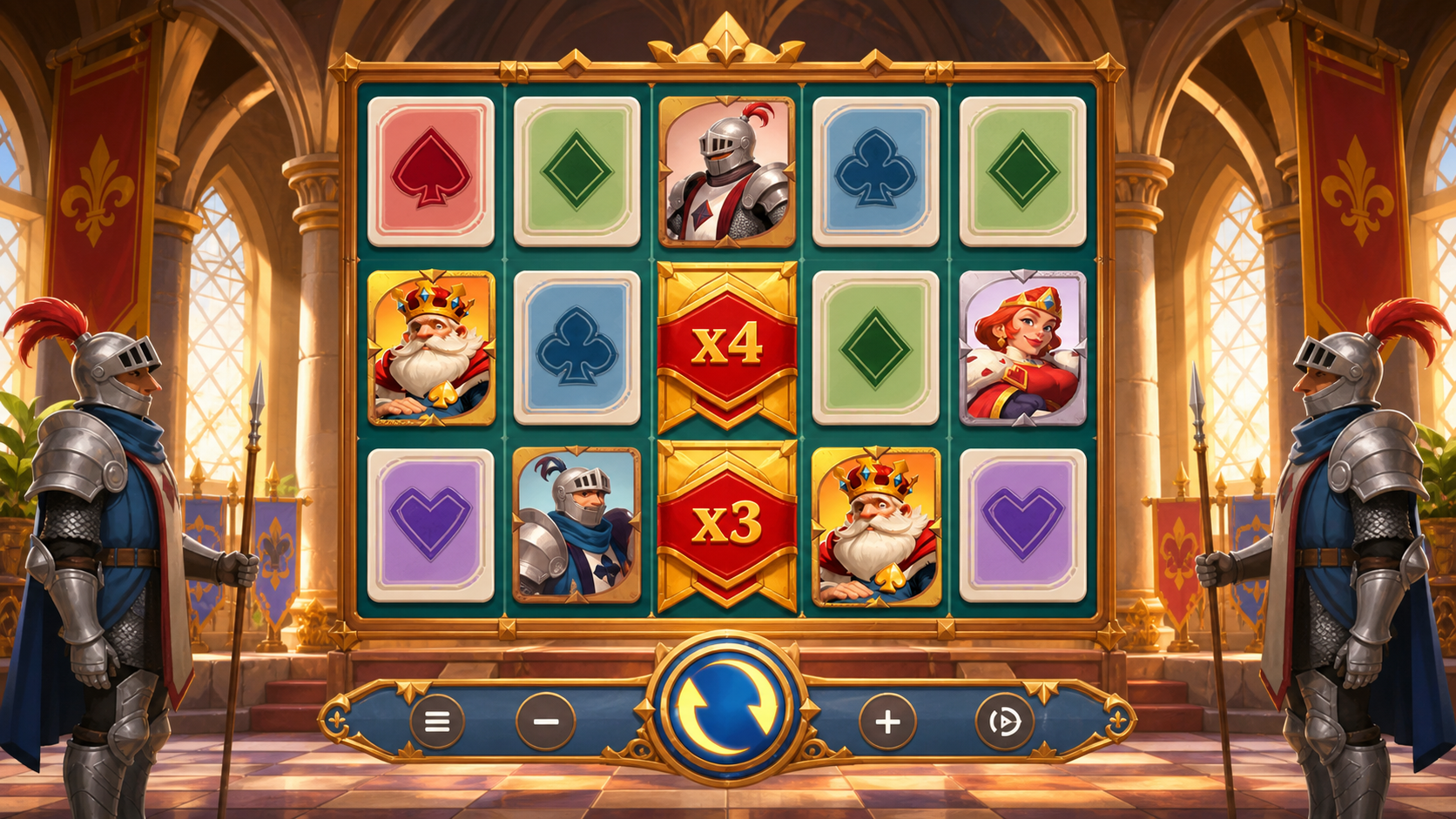
The strongest bonus boards are not necessarily those that collect the largest single number. Distribution can matter more. Three useful carriers across reels two, three and four may connect far more ways than one oversized carrier isolated on a single reel.
Position also affects the result. Locking a carrier into the only space needed by a particular symbol may help repeatedly. Locking several unrelated regular symbols can clutter the middle reels and reduce their immediate compatibility. The random odd-value transformations stop the bonus from following a predictable upgrade path.
This produces a free-spin round with genuine board development, but no player decision changes the transformation. There is nothing to select, hold or exchange manually. The system remains random from the trigger through the final evaluation.
Wild Behaviour Is More Complicated Than It First Appears
The ordinary Wild replaces regular paying symbols but not the Scatter. An even Multiplier-Ways carrier also acts as a Wild while retaining its virtual stack value.
That second version is considerably more important. A plain Wild fills one reel position. An x4 Wild carrier represents four matching positions for the ways calculation. Its influence therefore comes from substitution and virtual stacking at the same time.
The advantage can be temporary. Once it joins another win and advances to an odd value, the carrier changes into a randomly chosen regular symbol. The next identity may connect with the current grid, or it may break a promising pattern.
This alternating behaviour keeps the mechanic from climbing in a straight line. The carrier repeatedly moves between a flexible even stage and a less flexible odd stage. Higher values raise the number of potential ways, but symbol compatibility still decides whether those ways exist.
The Paytable Is Built Around Readable Hierarchy
The four suit tiles occupy the lower portion of the symbol ladder. Red and blue knights sit above them, followed by the queen and king.
PG does not overload the screen with separate bonus icons. The Scatter chest is visually distinct, while the numbered carrier uses existing character and suit artwork. This helps the player recognise its current identity without opening the rules panel after every transformation.
The royal characters also serve a practical purpose on a small phone screen. Their faces and armour remain easier to distinguish than traditional card ranks reduced to tiny rectangles. Red and blue uniforms separate the two knights, while the king and queen use different frame colours and silhouettes.
The background stays subdued during ordinary rounds. Stone arches and castle windows fill the unused sides of a landscape display, while the actual game remains portrait-oriented in the centre. On a phone, the same layout concentrates the important information around the reels and spin controls.
Sound and Animation Know When to Step Back
Poker Kingdom Win uses card movements, metal accents and short royal fanfares rather than a constant wall of noise. Basic spins resolve quickly. Cascades receive clearer audio cues, and the transformation of a carrier is treated as a separate event so the value change does not disappear inside the symbol removal animation.
The game becomes louder during free spins, where locked carriers need stronger visual separation from ordinary tiles. Gold frames, chains and warmer background colours identify the accumulated positions.
PG’s presentation is technically clean, though it sometimes makes an ordinary cascade look more significant than its payment. Watching the amount panel remains necessary. A long animation chain may reflect several small ways rather than a large cash result.
Turbo mode can reduce the waiting time, but it also makes the odd-to-even carrier changes harder to follow. Normal speed is more useful during the first few sessions because it reveals exactly why a tile became Wild or changed character.
What Poker Kingdom Win Gets Right
The strongest part of the design is the relationship between cascades and virtual stacks. They are not two unrelated systems placed on the same grid. A cascade upgrades the carrier, the new value changes its identity, and that identity determines which ways may form next.
The free-spin rule also builds directly on the base mechanic. Instead of adding a separate wheel or pick screen, it changes the lifetime of the existing carriers. Temporary positions become persistent ones.
Several smaller decisions also work well:
The current number of winning ways remains visible above the reels
Carrier values stay readable without covering the character artwork
The three eligible middle reels are easy to identify
The bonus does not hide its remaining spin count
The 10.2 MB initial download is relatively light for this level of character animation
Where the Crown Slips
The 5,000x maximum is not especially large beside the high-variance classification published by review databases. Some players may accept long quieter stretches more readily when the mathematical ceiling is higher.
The bonus cannot be extended, and the official description does not advertise a purchase route. Access therefore depends on landing the required Scatters during normal play.
Random odd-value transformations are also capable of producing frustrating boards. A carrier may reach x5 yet become a symbol that cannot connect with reel one. The mechanic looks as though it is always improving, but numerical growth and practical usefulness do not move together.
The poker theme remains cosmetic. Anyone expecting actual hands, strategic choices or a duel against the royal characters will find none of those elements. Poker Kingdom Win is a cascading ways slot wearing poker artwork, not a hybrid poker game.
Reading the Screen Without Chasing It
No betting pattern changes the random result. The useful skill here is understanding what has already happened.
Check the outer reels before reacting to a large middle value. An x5 carrier is only relevant when reel one begins a compatible combination. Watch the carrier’s parity as well: even means Wild, while odd means a randomly chosen regular tile.
During free spins, several smaller locked carriers across different reels may create a stronger structure than one large carrier. That observation explains the result; it does not predict the next spin.
Stake steps, currencies and autoplay settings may differ between Philippine-facing casinos because operators configure their own front ends. The game’s published RTP should also be checked inside the local information menu where available. Real-money play should remain restricted to funds that are not needed for regular expenses.
The Royal Verdict
Poker Kingdom Win succeeds when its numbered tiles start moving through their odd and even states. A carrier enters as x3, becomes an x4 Wild after joining a win, then may reappear as an x5 king or knight. Cascades give that change immediate consequences, while free spins stretch the same process across several rounds.
The result is more thoughtful than the royal cartoon surface suggests. It is still entirely luck-based, and many paid spins end before the central system has time to develop. The 5,000x ceiling and non-retriggering bonus also place firm limits on the chase.
PG Soft has built a slot around one coherent mechanical idea rather than a pile of disconnected bonuses. Poker Kingdom Win works best for readers who enjoy watching a grid evolve and who understand that a larger carrier value is only useful when the surrounding reels complete the hand.
Image note: The three inserted visuals are high-resolution editorial recreations based on PG Soft’s official character material and verified game layouts. They contain no third-party website watermark and are not presented as untouched official screenshots.
By Fairy Editorial - 24 Jul 2026

Coin Volcano
Coin Volcano Review: A 3×3 Slot Where the Base Game Is Only the Fuse
Coin Volcano strips away almost everything associated with a conventional slot. There are no fruit symbols, card ranks, Wild substitutions or ordinary paylines. The nine reel positions contain only coins and special objects, while the base game works primarily as an entry point to a Hold and Win round.
The central question is not which symbols match. It is how quickly the middle row fills, how many Sticky Coins survive until the trigger, and what happens after the volcano starts throwing multipliers across the grid.
That gives Coin Volcano a narrow but unusually concentrated identity. Nearly every symbol belongs to the same collection system, so a session moves between quiet trigger-building spins and dense bonus rounds where all nine positions matter.
The Numbers Before the Eruption
Coin Volcano was released by 3 Oaks Gaming in August 2023. It runs on a 3×3 grid and does not use traditional paylines or free spins.
The commonly listed mathematical settings are:
RTP of 95.66 percent
Medium volatility
Maximum result of 2,551x the total bet
Regular Bonus Game purchase at 30x
Ultra Bonus Game purchase at 75x
Mini Jackpot at 10x
Minor Jackpot at 20x
Major Jackpot at 50x
Grand Jackpot at 500x
Bet limits depend on the casino build and currency. Public listings commonly show a starting stake of 0.10 and an upper limit between 50 and 60.
The RTP and maximum result come from the currently distributed database version. An operator may run another approved configuration, so the information menu inside the loaded game remains the final reference.
The Base Game Does Not Behave Like a Normal Slot
A paid spin moves nine positions arranged across three columns and three rows. Landing two matching coins has no meaning, and forming a diagonal does not create a payout.
Instead, the middle row acts as the activation line. Three qualifying symbols occupying that row start the Bonus Game with three respins.
The top and bottom rows are not entirely irrelevant before the trigger. A Sticky Coin may remain fixed on the board while later spins attempt to complete the central line. Once the bonus starts, held symbols are transferred into the respin grid.
This changes how the base game should be read. A regular slot asks you to follow winning combinations. Coin Volcano asks you to follow progress toward a condition.
The game does not hide that structure. The 3×3 grid is large, the centre line is easy to recognise, and each special coin uses a distinct label. The volcano sits beside the reels as a meter and as a visual warning that the real calculation has not started yet.
Sticky Coins Give Otherwise Empty Spins a Memory
The Sticky Coin is the bridge between one paid spin and the next. It remains locked until the Bonus Game activates instead of disappearing with the rest of the grid.
A locked coin does not mean that a payout is guaranteed. It simply preserves one useful position while subsequent spins search for the remaining trigger symbols.
This is one of the few persistent states in the base game. Ordinary symbols are replaced after each spin, but a Sticky Coin creates visible progress. Two sticky positions can make the trigger look close, although the next result remains random.
The distinction is important because persistence often creates the impression that a bonus is due. A Sticky Coin improves the visible setup according to the game rules, but it does not turn later spins into a predictable sequence.
When the middle row finally fills, the screen shifts into the Hold and Win calculation.
Three Respins and Nine Positions
The Bonus Game starts with three respins. Every symbol already involved in the trigger remains fixed, while unoccupied positions spin again.
A new coin landing in an empty cell is locked in place and resets the counter to three. Several successful respins can therefore extend the round far beyond its initial length.
A blank respin reduces the counter by one. The round finishes when the counter reaches zero or all nine cells become occupied.
This creates two simultaneous targets:
Collect valuable coins before the respins disappear.
Fill every grid position to secure the Grand Jackpot.
The second target is difficult because each new symbol reduces the number of open cells. Early in the round, several positions may accept new coins. Near the end, the entire bonus can depend on one remaining square.
That final empty cell is where Coin Volcano produces most of its tension. The respin wheel may repeatedly return to three while the board is filling, but once only one space remains, every blank result feels much more expensive.
Regular Coins Are Only the First Layer
Standard Bonus Coins carry cash values linked to the current total stake. Public game data places the normal range around 1x to 4x, though specific values are displayed directly on each coin.
A board full of small coins may look impressive without creating a particularly large result. The important details are the printed values and any multipliers attached to their cells.
Jackpot Coins bypass that ordinary value range:
Mini pays 10 times the bet.
Minor pays 20 times the bet.
Major pays 50 times the bet.
Grand pays 500 times the bet when the required grid condition is completed.
The jackpot amounts shown above the reels scale with the selected stake. In the official screenshot, a 10.00 bet displays 100.00 Mini, 200.00 Minor, 500.00 Major and 5,000.00 Grand values.
These are fixed multipliers rather than a shared progressive jackpot. Their displayed cash amounts change with the bet, not with activity from other accounts.
Mystery Symbols Delay the Calculation
A Mystery symbol lands as a cracked volcanic rock without immediately showing its final identity. It can transform into another permitted symbol, excluding the Sticky Coin.
Possible outcomes include an ordinary cash value, a Collect symbol or another special result. The hidden identity gives the respin a second stage: the position is secured first, and its financial value becomes clear afterward.
The Mystery Jackpot uses a separate transformation pool. It reveals a Mini, Minor or Major Jackpot rather than an ordinary cash coin.
This separation matters. A standard Mystery may turn into several functional symbols, while Mystery Jackpot guarantees that its final result comes from the three eligible jackpot levels.
The Grand Jackpot is not included in that reveal. It remains tied to filling the required grid.
Several Mystery objects on the same board can change the value of a round sharply. A promising screen may reveal low cash coins, while an ordinary-looking layout may uncover a Major Jackpot and a useful Collect symbol.
What the Collect Coin Actually Does
The Collect symbol gathers the current values of eligible coins and jackpot prizes already visible on the board.
Its strength therefore depends on timing. A Collect landing early may gather only a few small amounts. The same symbol arriving after the grid has accumulated large coins, jackpots and multiplier positions has much more to work with.
The Collect Coin does not need to remain until the final respin to matter. It performs its collection according to the active board state, while the Hold and Win round may still carry on afterward.
This creates the possibility of collecting existing values and then adding more coins during later respins. Another Collect result can gather the updated board again if the symbol system produces one.
The best-looking screens are not automatically the most productive. A board with several valuable coins but no Collect symbol may finish with a straightforward total. A Collect arriving after the board has been multiplied can change the calculation much more aggressively.
Volcano Multipliers Change Individual Cells
During a Bonus Game, the volcano may activate and throw from one to nine multiplier effects onto the grid. The selected positions receive modifiers such as 2x, 3x, 4x or higher values allowed by the game configuration.
The multipliers belong to grid positions rather than acting as one global multiplier across the entire bonus.
A 10x coin sitting on a 2x cell becomes more valuable than the same coin in an unmodified position. A Mini, Minor or Major Jackpot may also land in a multiplied cell, as shown by the official game screens.
More than one volcanic effect may hit the same position. When this happens, the cell values build according to the displayed multiplier state.
This is why an apparently modest grid can develop into a large result. The original coin amount may be small, but the position underneath it can acquire extra weight before the round is settled.
The animation is not merely decorative. The falling column of fire identifies the exact cell receiving the volcanic modifier, and the multiplier remains printed near that position afterward.
The Ultra Bonus Starts With More Heat
Coin Volcano contains a second Hold and Win mode called the Ultra Bonus Game.
It may activate randomly from the base game. Some operator versions also place it beside the normal Bonus Game inside the purchase menu.
The regular purchase commonly costs 30 times the current bet. The Ultra version costs 75 times the bet.
The price difference comes from the multiplier conditions. Ultra Bonus guarantees a Volcano Multiplier event at the beginning of the round and carries a stronger chance of further volcanic activations.
The respin framework remains familiar: symbols lock, new landings reset the counter, and a full grid leads to the Grand Jackpot. What changes is the number of cells likely to receive multipliers.
The guarantee does not guarantee a profitable round. A large purchase cost can still lead to a board containing low-value coins, poorly placed modifiers or too few collected symbols.
The word Ultra describes the added multiplier treatment, not a minimum payout.
The Volcano Meter Is More Important Than It Looks
The volcano beside the grid is not just background artwork. Its meter fills as qualifying symbols land on the active line.
Once full, the meter activates the associated bonus round. This gives the base game a visible progress system alongside the direct three-symbol trigger.
The meter helps prevent every losing spin from looking identical. A result may fail to start the bonus while still adding to the volcano’s state.
However, visible progress should not be confused with a precise countdown. The meter indicates movement toward its programmed condition, but it does not let the player determine the value of the coming Hold and Win board.
Its main purpose is structural. Coin Volcano needs a reason for the base game to exist when there are no standard symbol payments, and the meter turns those spins into a loading phase for the respin system.
Why the 3×3 Grid Works
Many Hold and Win games use five reels and three rows, leaving 15 positions to fill. Coin Volcano cuts the board to nine.
The smaller grid has three effects.
First, every landed symbol occupies a larger percentage of the available space. Adding one coin to a four-symbol board visibly changes the round.
Second, the Grand Jackpot target looks attainable sooner. Reaching seven or eight occupied cells creates a clear final objective without forcing the eye to scan a large reel window.
Third, multiplier placement becomes easier to understand. When the volcano marks a cell, its relationship to the coin occupying that position is immediately visible.
The cost of this clarity is limited variety. The game spends nearly all its time on one small board. There are no character symbols, changing locations or separate free-spin reels to break up the session.
Reading a Bonus Screen Correctly
A busy Coin Volcano screenshot can contain several calculations at the same time:
The cash number printed on each ordinary coin
Mini, Minor and Major Jackpot symbols
Hidden Mystery outcomes
Cell multipliers
Collect Coins
The remaining respin counter
The number of unoccupied cells
The Grand value above the grid
The largest coin animation is not always the most important part. A modest coin sitting on a heavily multiplied cell may be more useful than a larger unmodified coin. A Collect result may also be worth more than its artwork suggests because it evaluates the rest of the board.
The respin counter deserves constant attention. A board with high values and three respins remaining has time to develop. The same board showing zero respins is already at settlement unless the final result filled the grid.
RTP, Volatility and the 2,551x Limit
The widely distributed build is listed with a 95.66 percent RTP. This represents the theoretical return across a very large volume of wagers, not the expected result from one purchased bonus or one short session.
The published medium-volatility label may feel misleading during individual sessions. The game concentrates nearly all payment activity inside bonus states, so the base game can feel much harsher than the word medium suggests.
The reported maximum result is 2,551 times the bet. The 500x Grand Jackpot forms one part of that ceiling rather than representing the entire maximum. Coin values, jackpot coins, Collect events and multiplier cells can combine inside the same round.
Reaching the mathematical limit would require an exceptional arrangement. The figure should be treated as a boundary of the model, not a target that becomes more likely after several failed bonuses.
Buying the Bonus Does Not Improve the Mathematics
The purchase menu shortens the path to the Hold and Win round. It does not make the random number generator easier to beat.
At a 1.00 stake, a 30x purchase costs 30.00 and the Ultra option costs 75.00. At 10.00, those costs become 300.00 and 750.00. The exposure rises immediately with the underlying bet.
A purchased Bonus Game may finish below its entry price. The same is true of Ultra Bonus despite its guaranteed initial multiplier event.
This makes the purchase option useful for testing the mechanics in Demo mode, where virtual credits can show how Mystery, Collect and multiplier cells interact. It should not be interpreted as a shortcut to profit.
Mobile Layout and Screen Readability
Coin Volcano uses a horizontal screen. The grid occupies the centre, the volcano and title sit to the left, while respin and menu controls remain on the right.
Landscape orientation is therefore the natural fit on a phone. A portrait browser may shrink the cash values and multiplier labels until they become difficult to distinguish.
The 3×3 board itself works well on smaller displays because only nine cells need to remain visible. Numbers are printed in large type, Jackpot colours stay consistent, and the respin counter is separated from the grid.
Turbo mode speeds through base-game trigger attempts, but normal speed is more useful during the bonus. Volcano strikes, Mystery reveals and Collect calculations happen in sequence, and skipping them can make the final total harder to audit.
Where Coin Volcano Holds Up
The design has almost no mechanical waste. Every object belongs to the same system, and the relationship between its parts is easy to trace.
Sticky Coins build toward the trigger. Respins lock new symbols. Mystery objects postpone their identities. Volcano effects modify cells. Collect Coins gather board values. Filling all nine positions leads to Grand.
The short path between these rules gives the bonus considerable density despite the small grid.
It is also refreshingly honest about its focus. Coin Volcano does not attach a thin free-spin round merely to lengthen the feature list. It commits fully to the Hold and Win structure.
Where the Formula Becomes Restrictive
The base game has little independent value. If the central trigger and meter progress are not enough to maintain interest, the paid spins can feel like a waiting screen.
A bonus may also end quickly after several empty respins. Three lives sound generous until no new symbol lands and the counter falls straight to zero.
The heavy use of red, gold and fire makes important objects clear, but long sessions have limited visual contrast. Almost every major animation involves a coin expanding, a rock cracking or the volcano erupting.
The 95.66 percent listed RTP is another drawback when compared with games running closer to 96 percent or above. Operator configuration still needs checking, but the standard published figure is not especially competitive.
Final Assessment
Coin Volcano is less a traditional slot than a compact Hold and Win machine with a paid loading phase.
The base game exists to prepare a nine-cell collection round. Once inside, the interaction between Sticky Coins, Mystery reveals, fixed jackpots, Collect symbols and position-based multipliers gives the small grid more depth than its size suggests.
Its best moments come when the volcano marks several occupied cells, a Mystery Jackpot reveals a stronger tier, and a late Collect symbol evaluates the improved board before the respins expire. Its weakest moments come when the base game takes time to trigger and the resulting bonus ends after three blank attempts.
The game suits short, concentrated bonus sequences better than long reel watching. Anyone expecting paylines, Wilds or free spins will find none of them here. Coin Volcano has one central idea: fill the board before the three-respin clock reaches zero, then hope the volcano has changed the right cells before the total is calculated.
Editorial note: A public Demo was located, but its embedded engine could not be controlled reliably in the current browser environment. The three inserted images come directly from the official 3 Oaks Gaming media interface. They contain no third-party watermark and were enlarged to 1536×864 or 2560×1440 with light sharpening.
By Fairy Editorial - 24 Jul 2026